Bukhara is an ancient, truly Eastern city straight out of a fairy tale. It radiates the charm of medieval history and the mystique of the East. Everything here is just as you’d imagine it to be.
You can start your journey at the Sarrafon Trading Dome. This tall brick structure features an open dome with entrances on all four sides. Underneath, vendors sell all sorts of intriguing tourist “curiosities.”
Right near the dome stands the Nogai Caravanserai from the 18th century. In fact, historical buildings are everywhere in the Old City. From the dome, you can already spot the famous Kalyan Minaret and yet another caravanserai.
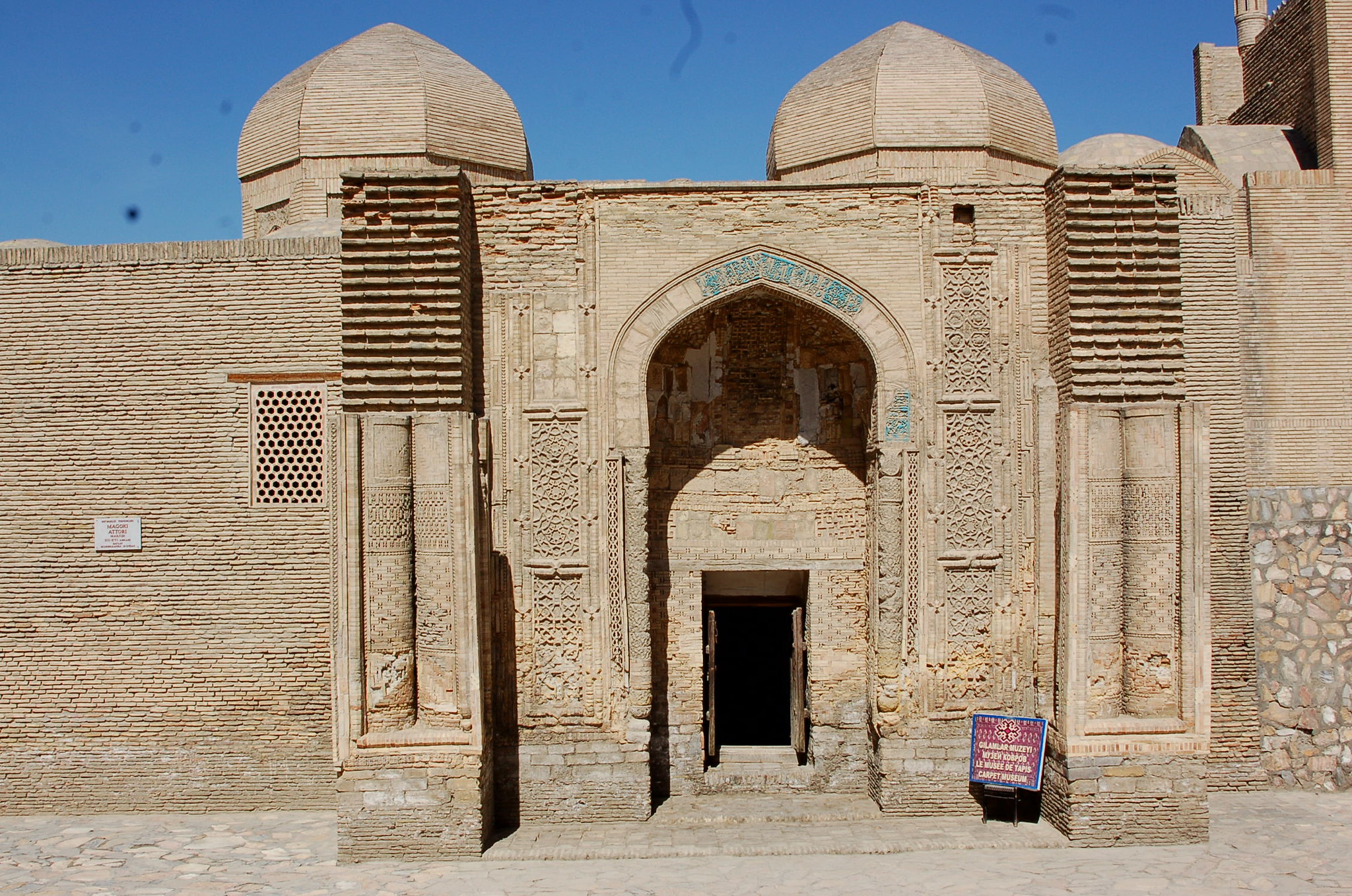
A short walk will bring you to one of the most fascinating sites in Old Bukhara — the Magok-i-Attari Mosque (Uzbek: Magʻoki attori masjidi, literally “Pit of the Spice Vendors”). It lies five meters below ground level and, according to Bukhara’s history, was built on the site of a Zoroastrian Moon Temple. Before the Arab conquest, this bazaar area was used for trading idols, medicinal herbs, and spices, which earned the mosque its nickname, “Mosque of the Spice Vendors.” Nearby, there was once a Moon Temple, which also inspired the name Magok-i-Attari (Persian: ماه, mâh).
By the early 20th century, the mosque was almost entirely buried under layers of cultural sediment accumulated over centuries, leading locals to call it an underground mosque. This origin gives it a unique, captivating architectural style with a remarkably well-preserved ornate facade. I highly recommend exploring this mosque carefully—it’s just steps away from the tourist heart of Old Bukhara, the Lyabi-Hauz complex.
Lyabi-Khauz Ensemble and Bukhara's Cultural Charm
The word “hauz” refers to a pond, and only a few remain in Uzbekistan. Many were filled in during the early 20th century due to health concerns, as they were breeding grounds for diseases like cholera, dracunculiasis, and malaria. In the Middle Ages, Lyabi-Hauz was a bustling trade square thanks to its proximity to the main commercial street with its trading domes (one is about 200 meters from the square) and the dense urban layout of Bukhara. The ensemble itself was constructed in the 16th–17th centuries.
Today, ducks swim in the pond, and the surrounding architectural monuments reflect beautifully on the water’s surface. The banks are lined with eateries and cafes. Unfortunately, we didn’t get the chance to eat there, but I’ve heard the prices are reasonable, and the aroma of shashlik is unbeatable.
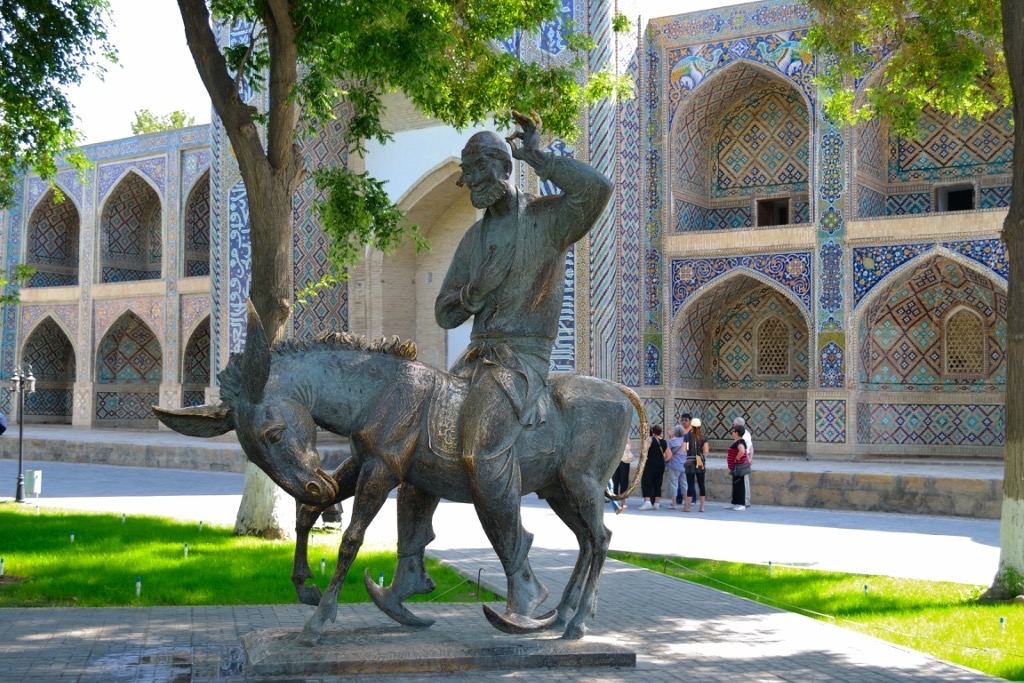
Nearby, along the almost-dry, murky city canal called Shahrud, you’ll find a park shaded by intricately carved trees. Here stands a monument to Khoja Nasreddin, a beloved and humorous folk hero. There’s always a line to take pictures with this charming statue. The beautifully crafted metal sculpture is full of personality and very photogenic—a must-see spot!
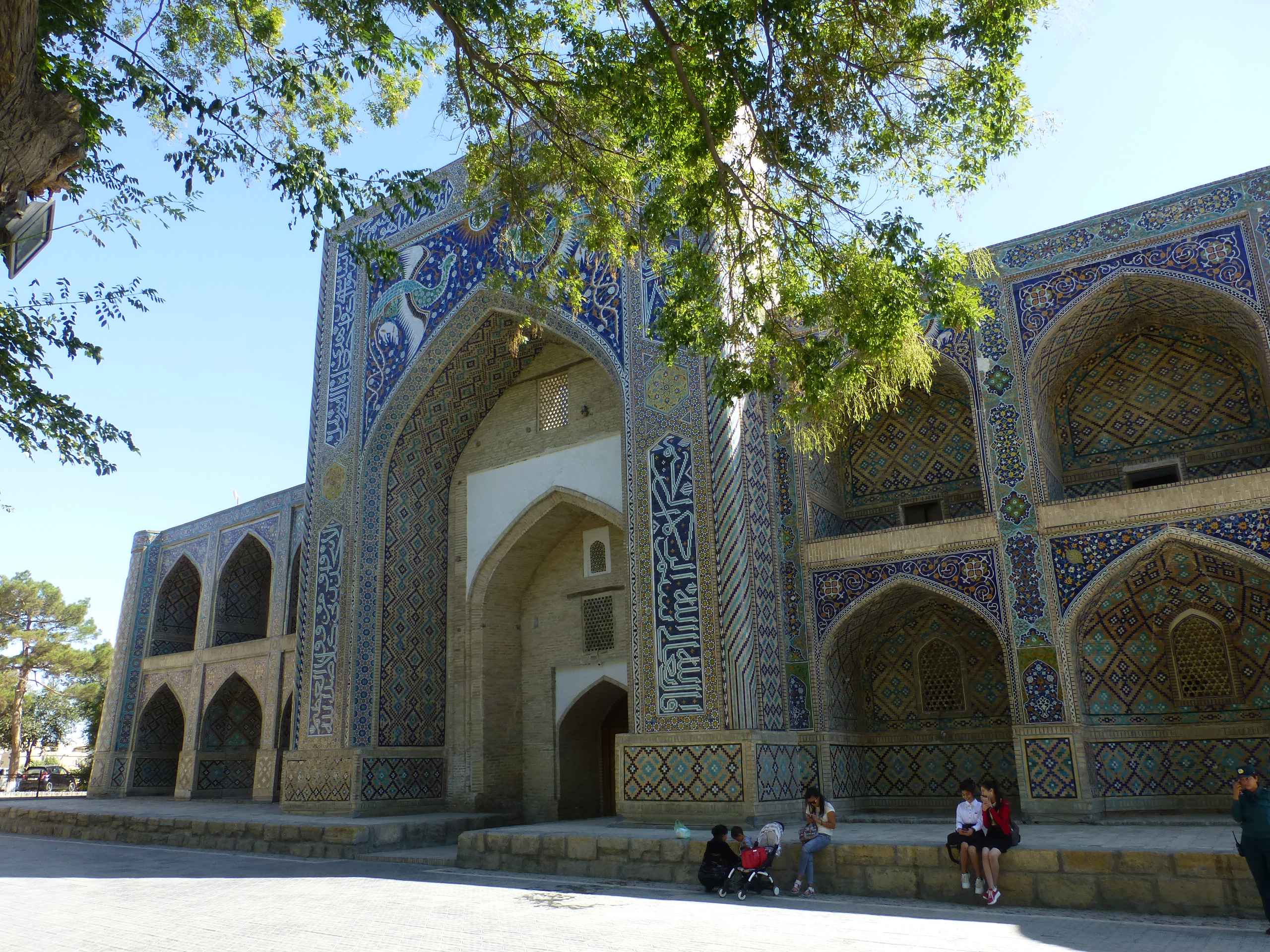
Lyabi-Hauz is surrounded by three architectural landmarks: the Kukeldash Madrasah (16th century), the Khanqah of Divan-Begi (a hostel for dervishes), and the Divan-Begi Madrasah, also from the 16th century.
In nearly every accessible madrasa courtyard, you’ll find vendors selling standard Bukhara souvenirs—ceramics, fabrics, bags, magnets, embossed dishes, and more.
Prices here can be steep! However, bargaining is a must, and the price can be significantly reduced—sometimes by 3–4 times. You can pay in various currencies, including Uzbek som, US dollars, euros, or Russian rubles, based on the current market rate in the city bazaars.
A white cloth bag made of coarse calico with traditional bright Uzbek embroidery costs $10–50 if it’s handmade. Beautiful ceramic figurines of dancers, warriors, and other intricately designed pieces make for excellent additions to any collection. These cost $5–20, depending on the craftsmanship, size, and level of detail. The most expensive souvenirs are stunningly beautiful brass plates with intricate engraving, ranging from $50, but typically priced around $100. High-quality steel knives crafted in traditional Uzbek style start at $30.
Every monument in the Lyabi-Khauz ensemble is worth close attention, just like Bukhara itself—a true testament to the ancient culture of the East. The mosque portals are adorned with unique, vibrant, and intricate ornaments, and some old carved wooden doors have been preserved, though many have been replaced by less expressive modern ones.
Bukhara, overall, gives the impression of experiencing challenging times. The facades of some monuments are partially restored but poorly lit, while the interiors of most require significant renovation.
Continuing our journey through ancient Bukhara, we headed toward the Ark, a large clay fortress that served as the residence of Bukhara’s emirs for centuries. Passing through another trade dome and navigating through rows of souvenir stalls, we reached the Bukhara Registan—a ceremonial square found in many Middle Eastern cities.
Kalyan Minaret
The Kalyan Minaret is one of the most striking sights in Bukhara, standing proudly under the city’s clear blue sky. Its diverse stone patterns, spanning from its base to the top, are mesmerizing and can be admired for hours. The best viewpoint for photographing this giant is slightly deeper into the square, from the steps of the small Amir Olimkhon madrasa.
Bukhara’s Registan partly comprises the Poi-Kalyan architectural ensemble. As the name suggests, this ensemble highlights the ancient Kalyan Minaret ("Kalyan" translates to "great" or "big"). Built in the 11th century, it remains one of Bukhara’s tallest structures, standing at 46.5 meters with a base diameter of 9 meters. A truly majestic and beautiful monument, unfortunately, its observation deck is closed to visitors.
Poi-Kalyan Square
The square is flanked on two sides by the grand Kalyan Mosque and the Mir-i-Arab Madrasa. While we didn’t visit the madrasa, skipping the Kalyan Mosque would have been unthinkable. Its massive azure dome is visible from many parts of Bukhara. The mosque, an active place of worship, is immaculately maintained and exudes an indescribable serenity—perhaps a characteristic of all sacred sites.
Inside, the mosque features a large open courtyard surrounded by covered balconies. The atmosphere is enchanting. Particularly captivating are the views of the madrasa and panoramic shots of the mosque’s dome alongside the Kalyan Minaret. Pigeons flutter under the grand dome, and the resonant echoes beneath it carry throughout the mosque.
The Ark Fortress
Our next stop was the Ark, the heart of ancient Bukhara. The fortress, first mentioned in the 9th century, served as a citadel and the residence of Bukhara’s emir and his elite entourage. According to historical accounts, up to 3,000 people lived within the fortress at the beginning of the 20th century. It housed the emir’s palace, government offices, workshops, a treasury, an arsenal, living quarters for nobility, warehouses for clothing, carpets, and weapons, and the royal treasury.
The Ark is shaped like an irregular rectangle elongated from west to east, with a perimeter of 789.6 meters and an internal area of 3.96 hectares. Its height from the Registan square varies from 16 to 20 meters. While most of the grand walls have crumbled, a small portion has been restored for visitors.
The fortress’s grand entrance and adjoining square are mostly empty, with a few tourists and local youth posing for photos against the ancient backdrop. Guided tours of the Ark, lasting 30–40 minutes, are available, covering all the accessible pavilions. This is the most extensive and cohesive medieval architectural composition in Bukhara and is definitely worth a visit. Highlights include the throne room, the reception hall, and guest quarters once used by Russian General Kaufman during the conquest of Central Asia.
Bolo-Hauz Mosque
Adjacent to the Ark is another hauz (water reservoir) and the Bolo-Hauz Mosque. Before the Revolution, this served as Bukhara’s main Friday mosque, where the emir himself prayed. Next to the mosque stands a mini-minaret, resembling a scaled-down version of the Kalyan Minaret. The mosque’s facade is adorned with stunning carved columns and intricately painted ceilings.
Beyond the Main Attractions
Other must-see sites in Bukhara include the Samanid Mausoleum, Chashma-Ayub complex, and the Karakul Gate, the second of Bukhara’s surviving medieval city gates.
Samanid Mausoleum
Located in a park that once housed an ancient cemetery, the Samanid Mausoleum stands out as an architectural marvel. Built between the 9th and 10th centuries, it features cubic forms, intricate yet austere brick patterns, and a low dome with protruding "spikes" that create a unique monumental style. Unlike most of Bukhara’s monuments, the Samanid Mausoleum reflects an earlier Zoroastrian influence rather than the dominant Arab aesthetic.
Inside, a single elevated burial chamber follows the traditions of neighboring Khwarezm. Light filters through carved mini-windows, creating an indescribable ambiance. Visitors can rest on a bench inside while reflecting or praying under the caretaker’s supervision.
Chashma-Ayub Mausoleum
Behind the Samanid Mausoleum lies the Chashma-Ayub ("Job’s Spring") Mausoleum, marked by a slightly tilted brick tower. Built in the 14th century, it currently houses a Museum of Water (which is not particularly engaging) and a well over a sacred spring.
According to legend, the prophet Job (Ayub) traveled through Bukhara’s lands as a preacher. During a drought, he struck the ground with his staff, and a healing spring appeared, which still provides drinkable water today. Under the dome is the well with slightly salty water, and beyond it lies a burial chamber.

Today we are returning to Samarkand from Bukhara. For everyone who still hasn’t decided — it’s better to leave three nights for Bukhara. It’s a very soulful, beautiful, vibey little city! No wonder it’s on the UNESCO list 💯!
Even though the old city is not very big, its atmosphere is like Venice — you just want to walk and get lost in its clean little streets. If you compare these two cities, it’s like the ceremonial Saint Petersburg and Kolomna, where it feels as if characters from Fyodor Dostoevsky are still wandering around. Talk with the locals and you’ll understand the intelligence, nobility, and kindness of these people.
And about everyday things: the food here is delicious! Don’t eat in places that are made only for tourists — for example at JOY Gastro Restaurant, like we did on the first evening. Yes, it’s beautiful there, but the cuisine is very expensive and disappointingly not tasty. Eat plov before 13:00 and after 18:00 in the places where locals eat — and the grilled kebabs there, wow 🤦♀️!
At the market — we liked it more than the Siab Bazaar — you can buy very beautiful chapans, chiffon ones, cotton ones, and even wool-like ones, for half the price compared to the old city.
In short, don’t come to Bukhara for just one day — this city deserves much more!