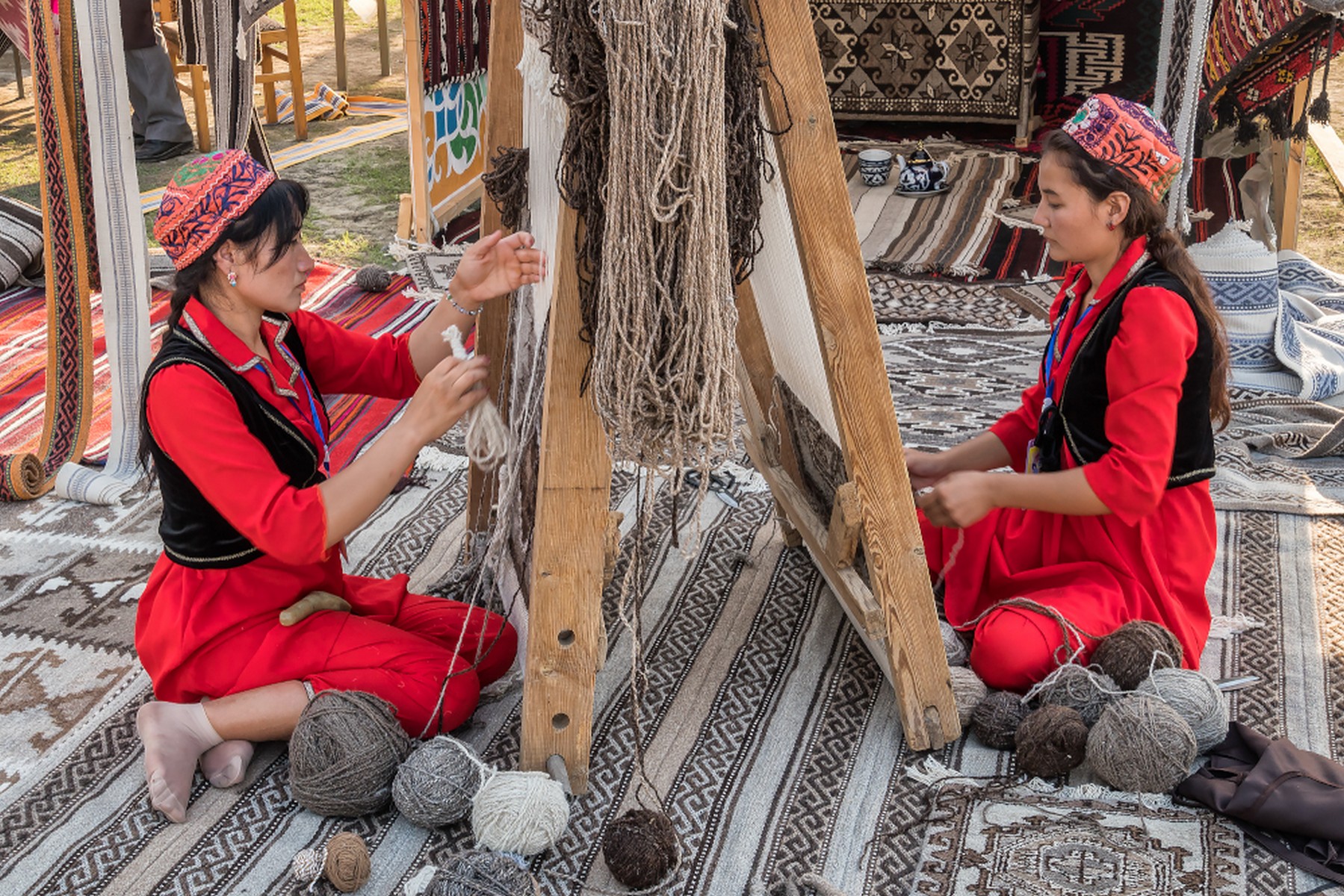
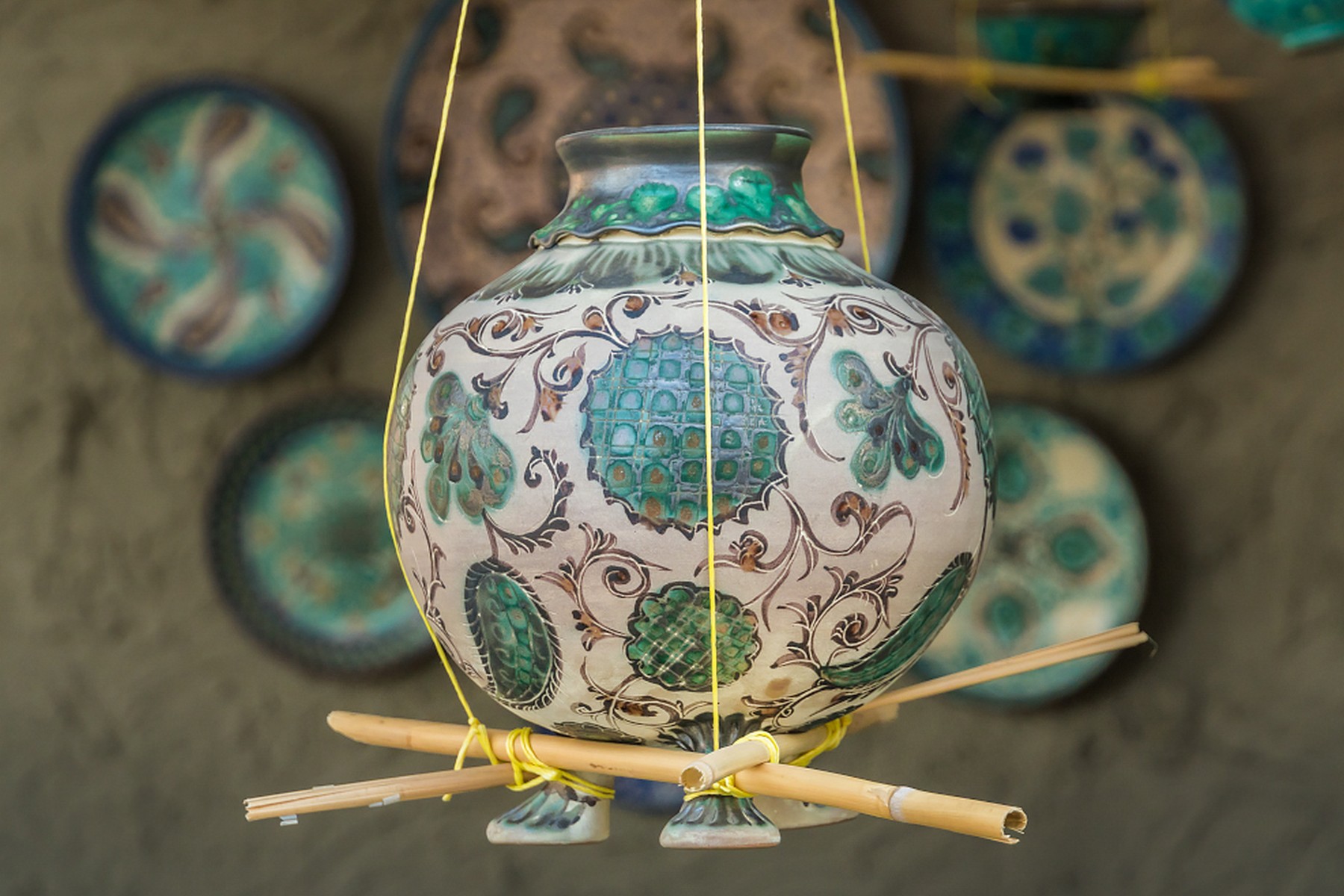
In the Fergana Valley, silk is still woven by hand, ceramics are still shaped from local clay, and traditional knowledge continues to pass from master to apprentice.
There is a version of Uzbekistan that most visitors know well. It has blue domes, monumental madrasas, ancient caravan routes and magnificent squares. Then there is another Uzbekistan, quieter and much less photographed. It begins when you leave the monuments behind.
In the eastern part of the country, the Fergana Valley is one of the places where Uzbekistan’s traditional culture is not simply preserved—it is still being made.
Here, a piece of silk begins as a cocoon. A ceramic bowl begins as a lump of local clay. A pattern that looks effortlessly spontaneous may require days of preparation before a single thread reaches the loom.
The remarkable thing is that these aren’t demonstrations designed solely for tourists. They are crafts. People make things, sell them, teach them and continue to adapt them to contemporary life.
Few places illustrate this better than Margilan. For centuries, the city has been associated with silk production, and it remains the Fergana Valley’s most important centre for traditional silk textiles.
Walk into a workshop and the process quickly destroys the romantic simplicity of the finished product. A colourful khan-atlas fabric may look like a single burst of colour, but producing its characteristic pattern involves extraordinarily careful preparation. Threads are grouped and tied according to the design before being dyed. The pattern gradually appears only when the threads are arranged and woven.
This technique is a form of ikat, a textile tradition found in several parts of Asia, but Uzbek atlas has developed its own unmistakable visual language. And it remains surprisingly labour-intensive.
Uzbekistan’s tourism authorities describe the famous Yodgorlik silk factory in Margilan as a place where visitors can follow the process from cocoons to finished fabric, with much of the production still carried out by hand.
The tradition is important enough that UNESCO selected the Margilan Crafts Development Centre’s safeguarding programme for atlas and adras production for its Register of Good Safeguarding Practices in 2017. The programme was created specifically to keep traditional skills alive through training, exhibitions, craft fairs and the transmission of knowledge to younger generations.
That last part is perhaps the most interesting. The real challenge isn’t making beautiful fabric. It is making sure that someone will still know how to make it fifty years from now.
There is another reason to look closely at atlas and adras. The patterns are not printed onto finished fabric. They are created during the preparation of the threads themselves. That gives traditional ikat its slightly blurred, almost dreamlike appearance. Lines don’t always meet with the precision we expect from industrial printing. Colours seem to bleed into one another.
What might look like an imperfection is actually part of the technique. The result is particularly striking when viewed up close. From a distance, you see a beautiful textile. Standing beside the loom, you begin to understand how much planning, memory and manual work is hidden inside it.
UNESCO notes that the Margilan safeguarding programme also encourages the use of natural materials and supports intergenerational transmission of the craft.
For travellers, that makes visiting a workshop far more interesting than simply buying a scarf in a bazaar. You can see the difference between an object and the knowledge behind it.


Travel west from Margilan and the material changes completely. The silk disappears. The clay arrives.
Rishtan, between Fergana and Kokand, is one of Central Asia’s most celebrated centres of ceramic production. Local pottery is particularly recognisable for its vivid blue and turquoise colours, intricate decoration and distinctive glazes.
The tradition is ancient. Uzbekistan’s official tourism information describes Rishtan as one of the oldest centres of ceramic art in Central Asia, with pottery traditions extending back roughly a thousand years. But again, the interesting question isn’t simply how old is it?
It is: Why did it survive? Part of the answer lies in the way knowledge has traditionally been transmitted. Rishtan’s ceramic tradition follows the master-apprentice model, with skills passed through practical work rather than simply written instructions. The local Craftsmen’s Centre currently brings together more than 20 artisan workshops and includes a museum dedicated to the history of traditional Rishtan ceramics.
This is an important distinction. A museum can preserve an object. A master can preserve a skill. And skills are much harder to preserve.
Visitors often associate Rishtan ceramics almost exclusively with blue. The colour is certainly spectacular, but the deeper story is the relationship between the potter and the material.
Local artisans work with the region’s distinctive clay and traditional glazing techniques. Forms range from large serving dishes and storage vessels to bowls, jugs and smaller everyday objects.
Many pieces are still functional. This matters. Traditional craft survives most successfully when it remains useful. A beautiful bowl that nobody uses eventually becomes a museum object. A beautiful bowl that appears on a family’s dinner table has another life.
This is where the Fergana Valley becomes particularly interesting for travellers. Traditional crafts here aren’t frozen in the past. They are changing.
A silk pattern that once appeared primarily on traditional clothing can now be found in contemporary fashion. A ceramic form developed for household use can become a modern decorative object. Workshops sell to international customers while still maintaining techniques learned locally.
The survival of tradition therefore doesn’t necessarily mean refusing modernity.
Sometimes it means finding a place for old knowledge inside the modern economy.
In 2023, ceramic arts in Uzbekistan were inscribed on UNESCO’s Representative List of the Intangible Cultural Heritage of Humanity. Uzbekistan’s broader UNESCO heritage portfolio also includes traditional silk production, while the Margilan atlas and adras initiative remains recognised as a model of cultural safeguarding.
These recognitions are significant, but they can also create a misleading impression. UNESCO inscriptions do not make a tradition alive. People do. The potter who teaches an apprentice. The weaver who trains a younger relative.
The family that continues to maintain a workshop because customers still want what they make. That is the real reason these traditions have survived.
If you’re travelling through Uzbekistan, the Fergana Valley is easy to treat as an optional detour. That would be a mistake if traditional culture is one of your reasons for travelling. Don’t simply visit Margilan to buy silk. Watch it being made. Don’t visit Rishtan only to purchase ceramics. Spend time in a workshop. Ask questions. Look at the tools. Watch how the artisan handles the material. Notice how many stages of the process you would never have guessed existed. And, if you buy something, ask who made it.
The answer may be more interesting than the object itself. In 2025, Uzbekistan also officially designated a mahalla in the Rishtan district as a “Tourist mahalla,” highlighting the country’s growing effort to connect visitors with local traditions and handicraft communities.
That development is worth watching—not because travellers need another tourist attraction, but because it reflects a broader change in the way people are discovering the Fergana Valley.
The region doesn’t need to imitate Samarkand. It has something different to offer. Samarkand shows you what the Silk Road built. The Fergana Valley shows you what the Silk Road taught people to make. And perhaps that is the more intimate way to understand a civilisation. Not through the monuments it left behind. But through the skills that people still carry in their hands.
A piece of Margilan silk or a Rishtan bowl can be beautiful. But the most valuable thing you can take home is the story of how it was made. Because once you understand the hours behind the pattern, the generations behind the technique and the person sitting at the loom or wheel, the object stops being a souvenir. It becomes a fragment of living culture. And that is something no monument can quite give you.