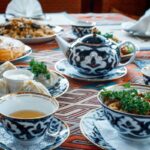
There are foods that travellers remember because they are spectacular: a steaming platter of plov, a table crowded with samsa, a mountain breakfast beside a yurt. And then there is bread.
Bread rarely receives the same attention. It arrives at the table almost unnoticed. A round loaf is placed beside tea, soup or a plate of meat. Someone tears off a piece. Someone else reaches for another. Eventually, the basket is empty.
Yet across Central Asia and the Caucasus, bread can tell you remarkably more about a place than a restaurant menu does.
In Uzbekistan it is non. In Kyrgyzstan and Kazakhstan, forms of traditional flatbread are made and shared in ways that can be closely tied to family and community. In Tajikistan, bread is an everyday presence at the table and in ceremonies. In Azerbaijan and Armenia, different bread traditions have their own rituals and meanings.
UNESCO has recognized several of these traditions as intangible cultural heritage, including Uzbekistan’s palov culture, Tajikistan’s oshi palav, Armenia’s lavash tradition, and the multinational tradition of making and sharing flatbread across Azerbaijan, Kazakhstan, Kyrgyzstan, Iran and Türkiye.
The interesting part is not that bread exists everywhere. It is what people do with it.
In Uzbekistan, bread is not simply something you eat. Walk through a neighbourhood in Uzbekistan early in the morning and you may notice the smell before you see the bakery.
Hot bread comes out of the tandyr, the traditional clay oven whose intense heat gives the loaf its characteristic crust and aroma. The bread is pressed against the inside wall of the oven and baked in minutes. The process is deceptively simple. It isn’t.
Traditional tandyrs themselves require specialized construction, and Uzbekistan has different forms of the oven depending on the region. Uzbekistan’s tourism authority describes vertical tandyrs associated particularly with Samarkand, Bukhara and Kashkadarya, while horizontal versions are traditionally used in Tashkent and the Fergana Valley.
The result is also far from a single national recipe. Different regions have their own breads, shapes, patterns and methods. There are non, patyr, shirmoi-non and katlama, among others.
For a traveller, this is one of those details that becomes interesting only when you stop treating bread as a generic food. Look at the bread on the table. Where was it made? How was it baked? What pattern is pressed into its surface? Was it bought from a neighbourhood bakery, prepared at home, or brought specially for guests? Suddenly, something that seemed ordinary becomes a small piece of local geography.


Uzbek bread carries meanings that go beyond food. Uzbekistan’s tourism authority describes a tradition in which people visiting another city buy bread to take with them, while bread is also associated with goodness and well-being. That makes bread particularly revealing for visitors.
Hospitality in Central Asia is often discussed in terms of enormous meals, endless tea and generous hosts. But hospitality does not always arrive as a spectacular feast. Sometimes it appears in a much simpler form: somebody making sure that there is enough bread for everyone.
This is one reason a meal in a family home can feel different from eating in a restaurant. The food may not be particularly elaborate. The significance is elsewhere. A guest is being included.
The story becomes even more interesting when you leave Uzbekistan. UNESCO’s documentation of the traditional flatbread culture shared by Azerbaijan, Kazakhstan, Kyrgyzstan, Iran and Türkiye describes bread-making as a social practice involving family members and, in rural communities, sometimes neighbours working together. The bread can be prepared in a tandyr, on a metal plate or in a kazan, depending on the local tradition.
The tradition is associated not only with ordinary meals but also with weddings, births, funerals and holidays. In other words, bread follows the same pattern found throughout the region: food becomes a social language.
You do not necessarily need to speak the language to understand what is happening. People are gathering. Someone is preparing something. Someone is offering it. Someone is being welcomed. Someone is being remembered.
In Kazakhstan and Kyrgyzstan, bread belongs to the table — but also to the landscape Travel through the mountains and steppe of Kazakhstan or Kyrgyzstan and the relationship between food and geography becomes particularly visible.
The ingredients change. The cooking methods change. The surroundings change. But the principle of sharing remains. This is especially noticeable when travelling outside the major cities.
A roadside meal, a family lunch, or food served during a stay in a mountain guesthouse can be very different from the polished versions of Central Asian cuisine found in restaurants.
That difference is worth seeking. Travellers sometimes approach regional cuisine as a checklist:
Try plov. Try beshbarmak. Try samsa. Try lagman.
But the more revealing question can be: Who prepared this food, and who is eating it with you? The answer often tells you more about local life than the recipe itself.
One of the pleasures of travelling through Central Asia is noticing how quickly seemingly small differences appear.
A loaf from one region may be flatter or thicker. Another may have a decorative centre. Some breads are dense and rich, while others are light and crisp.
Uzbekistan’s regional variety is particularly striking. Even its famous samsa has numerous local versions: Jizzakh’s large meat-filled samsa, Bukhara’s triangular varieties, thin-crusted Alot samsa and several others are associated with particular places and techniques.
Bread works in much the same way. It is a reminder that Central Asia is not a single culinary culture. The countries may share ingredients, techniques and historical influences, but local traditions have continued to develop in different directions.
Sometimes the best bread is found where you were not looking. This is where travelling slowly makes a difference. A traveller following the classic itinerary might visit Samarkand’s Registan, photograph Bukhara’s minarets and walk through Khiva’s old city. All worthwhile.
But somewhere between those famous places, there may be a small bakery where people are queuing for bread. There may be a neighbourhood oven. There may be a roadside stall where the bread is still warm. There may be a family guesthouse where breakfast consists of nothing more complicated than fresh bread, cream, fruit and tea.
Uzbekistan’s tourism authority describes this kind of traditional breakfast around freshly baked bread, cream, tea, honey and fruit. It is easy to overlook. It may also become one of the memories you.


There is a tendency to think of traditional culture as something preserved behind glass. Bread challenges that idea. A recipe survives because somebody continues making it. An oven survives because somebody continues using it. A technique survives because somebody teaches it to another person.
UNESCO’s documentation of flatbread-making specifically describes transmission through participation within families and through master-apprentice relationships. The same principle appears elsewhere in Central Asian culture: crafts, cooking techniques, music and other traditions remain alive when they continue to have a place in everyday life.
That is why a working bakery can sometimes tell you more about cultural continuity than a museum display. The object is not being preserved. It is being used.
If you want to experience Central Asian food more deeply, try something simple on your next journey. Instead of asking only where you can eat the region’s most famous dish, look at what local people are buying. Visit a market early in the morning. Notice where people are carrying fresh bread. Ask your guide where they would buy bread for their own family.
If you are staying in a guesthouse, ask whether the bread is locally baked. When somebody offers you homemade bread, accept it. And don’t be afraid to eat it simply.
A warm loaf, some fresh cream, tea and fruit can tell you something about Uzbekistan that an elaborate tasting menu cannot.Because the real story of Central Asian food is not only about recipes. It is about sharing.
The next time a basket of bread appears on your table in Central Asia, don’t dismiss it as a side dish. Look at it. Ask where it came from. Notice who reaches for it first. Watch how it is broken and shared.
In Uzbekistan, bread can accompany a simple breakfast, a family gathering or a formal celebration. Across neighbouring countries, related traditions connect bread with hospitality, community and important moments in life. UNESCO’s heritage records make clear that these practices are not merely culinary techniques but social traditions.
And that may be the most useful lesson for any traveller: sometimes the best way to understand a culture is not to look at its monuments, but at what people put on the table when they invite you to sit down.