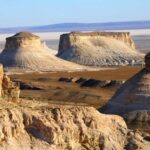
The wider region offers another reason to extend a journey beyond Muynak: the extraordinary archaeological heritage of ancient Khorezm.
Scattered across the desert are the remains of fortified settlements that once formed part of an important network of towns and defensive structures.
Two of the best-known sites are Ayaz-Kala and Toprak-Kala.
Ayaz-Kala consists of impressive fortress ruins rising above the surrounding desert landscape. Its elevated position offers expansive views, while the remains of its walls and towers give visitors an idea of the scale of ancient defensive architecture.
Toprak-Kala, meanwhile, was an important urban and political centre of ancient Khorezm. Archaeological discoveries have revealed traces of monumental buildings, residential areas and administrative structures, providing insight into the organisation of the region’s early settlements.
These fortresses are particularly rewarding for travellers interested in archaeology and history. Unlike the restored monuments found in more popular tourist destinations, the desert ruins retain a raw and atmospheric character.
They can also be combined with a journey between Nukus and Khiva, making it possible to explore the archaeological heritage of Khorezm as part of a broader regional itinerary.

There are places you visit for their beauty, others for their history, and a few that leave you thinking long after you have returned home. The Aral Sea region in north-western Uzbekistan belongs to the last category.
Once one of the largest inland bodies of water on Earth, the Aral Sea was a thriving centre of fishing and trade. Its shores supported communities, ports and fishing fleets. Today, much of the former seabed has become desert, old fishing boats lie stranded far from the water, and entire towns have had to adapt to a dramatically changed environment.
Yet a journey to the Aral Sea is not simply an excursion to see the remains of an environmental disaster. It is also an opportunity to discover Karakalpakstan, a fascinating and less-visited part of Uzbekistan with its own cultural identity, archaeological treasures, remarkable art collections and vast desert landscapes.
For adventurous travellers, photographers and anyone interested in understanding Central Asia beyond its famous Silk Road cities, this is one of the country’s most unusual journeys.
The natural starting point for an Aral Sea expedition is Muynak (also spelled Moynaq), a town approximately 200 kilometres north of Nukus, the capital of Karakalpakstan.
It is difficult to imagine that Muynak was once a busy fishing port. During the Soviet period, its economy revolved around the Aral Sea. Fishing vessels operated from the harbour, fish-processing facilities provided employment, and the town was closely connected to the fishing industry.
As the sea began to retreat, Muynak gradually lost its connection to the water. The harbour fell silent, fishing businesses disappeared, and the coastline moved farther and farther away.
Today, the town’s most recognisable landmark is the Ship Cemetery, where rusting fishing vessels rest on the former seabed. Their enormous metal hulls, surrounded by sand and sparse desert vegetation, create an extraordinary landscape that is difficult to associate with the idea of a former seaport.
Visitors can walk among the remaining boats, photograph their weathered structures and explore the surrounding area. A memorial overlooking the former shoreline offers another perspective on the scale of the environmental transformation.
It is worth remembering that these vessels are more than unusual photographic subjects. They represent the livelihoods of fishing families and a way of life that disappeared within a few decades.
A visit to Muynak is therefore best approached with curiosity and respect, taking time to understand the human story behind the landscape.
The disappearance of much of the Aral Sea is one of the most significant environmental disasters of the twentieth century.
The main cause was the diversion of water from the Amu Darya and Syr Darya rivers, which historically supplied the sea. Beginning in the 1960s, large-scale irrigation projects expanded across Central Asia, particularly to support cotton cultivation. Increasing amounts of river water were diverted to agricultural fields instead of reaching the Aral Sea.
As a result, the sea began to shrink dramatically. Water levels fell, salinity increased, fisheries collapsed and the surrounding communities experienced profound economic and environmental changes.
As the water retreated, large areas of exposed seabed were left behind. Wind erosion can carry salt and dust from these surfaces into surrounding areas, creating additional environmental and public-health challenges.
The landscape visible around Muynak today is a powerful reminder of how decisions about water management can transform an entire region.
There is also an important distinction between the former shoreline and the sea that remains. Visiting the Ship Cemetery does not mean reaching the present-day water’s edge. The remaining shoreline is much farther away and requires a separate journey across remote desert and plateau terrain.


Before heading north towards Muynak, travellers should spend time in Nukus. At first glance, the city may seem like a quiet regional centre, but it holds one of the most remarkable museum collections in Central Asia.
The I.V. Savitsky State Museum of Arts is often nicknamed the “Louvre in the Desert”. Its collection includes an extraordinary range of Russian avant-garde paintings, alongside Karakalpak folk art, traditional textiles, jewellery and archaeological objects from the region.
The museum owes much of its identity to Igor Savitsky, an artist and collector who worked in Karakalpakstan and devoted decades to collecting and preserving artworks. During a period when many avant-garde artists were marginalised or censored in the Soviet Union, Savitsky acquired works that might otherwise have been lost or forgotten.
Today, the collection offers visitors an unusual encounter between European modernism and the artistic traditions of Central Asia.
Allow several hours for the museum rather than treating it as a quick stop before the drive to Muynak. Its collection is extensive, and the regional art and archaeological sections deserve as much attention as the internationally recognised paintings. For many travellers, discovering this museum becomes one of the unexpected highlights of their visit to Uzbekistan.
Another fascinating destination near Nukus is Mizdakhan, a large historical and religious complex close to Khodjeyli.
Spread across a series of hills, the site contains mausoleums, burial structures and the remains of ancient settlements from different periods. Its layered history makes it an important archaeological and cultural landmark in Karakalpakstan.
Mizdakhan is also surrounded by local legends. One of its best-known stories concerns the so-called World Clock, associated with the belief that the end of the world will come when its remaining bricks fall. Such traditions have contributed to the site’s atmosphere and made it a place of particular interest for visitors fascinated by the intersection of history, religion and folklore.
Walking through the complex, travellers encounter a landscape very different from the grand monumental architecture of Samarkand or Bukhara. The atmosphere is quieter and more contemplative, with old brick structures standing against the open desert horizon.
Mizdakhan is an excellent addition to a regional itinerary, especially for those travelling between Nukus and Muynak.


For travellers who want to see the water that remains of the Aral Sea, a visit to Muynak alone will not be enough.
Reaching the present-day shoreline requires a much longer expedition, usually involving a four-wheel-drive vehicle and travel across remote areas of the Ustyurt Plateau and the former seabed.
The journey itself is part of the experience. The scenery changes from flat desert plains to dramatic cliffs, salt-covered surfaces and vast open landscapes. In some areas, the horizon seems almost endless, creating the impression of travelling through another world.
Depending on the route and conditions, expeditions may include stops at former settlements, abandoned infrastructure, unusual geological formations and viewpoints overlooking the remaining water.
Some itineraries also include an overnight stay in a traditional-style yurt camp near the shoreline. Spending the night in this remote environment offers a chance to experience the silence of the desert, watch the changing colours of the landscape at sunset and enjoy an exceptionally clear night sky when conditions are favourable.
These longer expeditions are not suitable for every traveller. Roads can be rough or absent, mobile coverage may be limited, and facilities are basic. It is strongly advisable to travel with an experienced local driver or organised expedition rather than attempting to navigate remote terrain independently.
The wider region offers another reason to extend a journey beyond Muynak: the extraordinary archaeological heritage of ancient Khorezm.
Scattered across the desert are the remains of fortified settlements that once formed part of an important network of towns and defensive structures.
Two of the best-known sites are Ayaz-Kala and Toprak-Kala.
Ayaz-Kala consists of impressive fortress ruins rising above the surrounding desert landscape. Its elevated position offers expansive views, while the remains of its walls and towers give visitors an idea of the scale of ancient defensive architecture.
Toprak-Kala, meanwhile, was an important urban and political centre of ancient Khorezm. Archaeological discoveries have revealed traces of monumental buildings, residential areas and administrative structures, providing insight into the organisation of the region’s early settlements.
These fortresses are particularly rewarding for travellers interested in archaeology and history. Unlike the restored monuments found in more popular tourist destinations, the desert ruins retain a raw and atmospheric character.
They can also be combined with a journey between Nukus and Khiva, making it possible to explore the archaeological heritage of Khorezm as part of a broader regional itinerary.


Most visitors discover Uzbekistan through the magnificent monuments of the Silk Road: the Registan Square in Samarkand, the historic streets of Bukhara and the fortified old town of Khiva.
Karakalpakstan offers a very different experience.
Here, the journey leads through remote landscapes, ancient archaeological sites and communities whose lives have been deeply affected by environmental change. The Savitsky Museum reveals an unexpected artistic heritage, Mizdakhan introduces centuries of history and folklore, and Muynak provides a direct connection to one of the world’s most significant ecological transformations.
The Aral Sea is not a conventional holiday destination, and its appeal does not lie in comfort or spectacular attractions alone. It is a place that encourages travellers to look beyond the scenery and understand the stories behind it.
For those willing to travel farther from Uzbekistan’s familiar tourist routes, the journey to the vanished sea can become one of the most meaningful experiences of their visit.
Most journeys to the Aral Sea region begin in Nukus, which has an airport with domestic connections, including flights from Tashkent. Nukus can also be reached by train from other parts of Uzbekistan, although journey times and availability depend on the service.
From Nukus, Muynak is approximately 200 kilometres away. The drive usually takes around three to three and a half hours, depending on road conditions and the route.
There are several ways to organise the journey:
A day trip from Nukus to Muynak is possible if the main objective is to visit the Ship Cemetery and local museum. However, reaching the present-day Aral Sea shoreline requires a longer expedition, generally involving a 4×4 vehicle and at least one overnight stay.
Travellers should distinguish carefully between these two experiences when booking a tour.
The most comfortable seasons for exploring Karakalpakstan are generally spring and autumn.
April and May offer relatively pleasant temperatures for travelling through the desert, visiting archaeological sites and spending time outdoors. September and October are also attractive, with cooler conditions and good opportunities for photography.
Summer can be extremely hot, particularly in exposed desert areas where shade is limited. Winter, meanwhile, can bring cold temperatures, strong winds and challenging weather conditions.
For longer expeditions across the Ustyurt Plateau, it is especially important to check local weather and road conditions before departure. Even during the recommended seasons, conditions in remote areas can change.