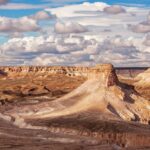
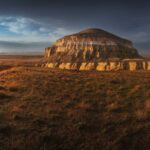
The Karakum Desert, a sprawling tapestry of arid wonders in Turkmenistan, unfolds like a colossal quilt stitched from diverse terrains—sandy dunes, loess plains, clay flats, rocky expanses, gravel fields, and salt-encrusted solonchaks. This boundless lowland stretches to the horizon, where the rugged cliffs and gorges of the Kopetdag Mountains plunge dramatically into a frozen “sea” of hilly foothills, marking the threshold to the desert’s heart. Within the Karakum, one encounters shimmering lakes nestled amid subtropical pockets, stark lifeless expanses of stone, clay, and gypsum, and vast tracts of shifting sands that whisper secrets of ancient winds and hidden life.
For those who’ve wandered its sun-scorched embrace, the Karakum exerts an irresistible pull—a siren call to return to the silent, heat-radiating dunes where existence awakens only under the veil of night. The memory lingers: the purest air, purified by the desert’s sands, tinged with the salty bite of winds, the bitter scent of hardy plants, and the rustle of reeds by scattered azure lakes. Endless barrows and their interconnected chains dominate the central Karakum’s landscape, while northern steppe-like regions, dotted with low-growing vegetation, encircle a necklace of lakes like Sarykamysh and Zangi-Baba. Here, saline wastelands give way to towering saxaul groves, forming surreal “forests” in the wilderness.
Beneath the Karakum’s surface lies a subterranean world of dense, hardened soils—buried takyrs (cracked clay flats), saline clays, gravel layers, soft solonchaks, or porous sandstones. Above them rise the shifting ridges, chains stretching for kilometers, with average dunes soaring over 30 meters. Blazingly bright and scorching for half the year, these sands trickle grain by grain, migrating in wind-swept zones, reshaping the terrain in a perpetual dance. Aeolian sands swirl into crests, cascade from golden hills, and veil the horizon in hazy curtains, conjuring mirages for weary travelers. Driven by fierce gusts, a typical dune in the central Karakum can advance up to six meters annually, even farther across flat takyrs, eternally redefining the desert’s visage.
The Karakum’s nature thrives on contrasts: spring bursts forth in a vibrant mosaic of wildflowers, transforming into parched desolation by summer, reviving with autumn rains, and appearing lifeless under winter’s bitter frosts. Many plants have evolved masterful adaptations to endure searing heat, arid air, and freezes—ephemerals rush to seed before summer’s wrath. As an Eastern proverb wisely notes, “Who has not been to the desert knows not the world.” Beneath the surface, the Karakum harbors rich mineral deposits and, despite its apparent aridity, substantial water reserves. Desert explorers gauge subterranean waters—fresh or saline—through flora: white saxaul perishes on salty soils, while black saxaul thrives on moderately saline earth, growing into sturdy, sprawling trees. Salt-laden groundwater reveals itself in halophytes like wormwood and saltworts, replacing freshwater-loving grasses.


Turkmenistan’s desert realm is safeguarded in two key reserves. The Repetek Biosphere Reserve, operational for over 90 years, boasts roughly a third of its plants as unique local species, with six narrowly endemic. Rodents dominate mammals, while reptiles include roundheads, Central Asian tortoises, and arrow snakes. Avian life fluctuates with seasons, hosting hundreds of bird species, and invertebrates number in the hundreds. Scientific exploration here spans over a century, initiated by the Imperial Russian Geographical Society under Vice-President P.P. Semenov-Tian-Shansky, the famed traveler. Subsequent luminaries included soil scientist V.V. Dokuchaev, geologist V.A. Obruchev, genetics pioneer N.I. Vavilov, mineralogist A.E. Fersman, geomorphologist B.A. Fedorovich, A.G. Babaev (founder of the Ashgabat Institute for Desert Study, now the National Institute of Deserts, Plants, and Animals), author Gerald Durrell, and biologist N.N. Drozdov.
The newer Bereketli-Karakumsky Reserve, established in 2013 on the northern edge of Akhal Province, spans over 87,000 hectares. Its ecological mosaic blends sandy, loamy, and saline deserts, serving as a vital breeding ground for the saker falcon. Within its bounds roam Red Book species like the golden eagle, great bustard, and goitered gazelle. Unique flora includes prized specimens: Sogdian tulip, Kandym snail, Maximowicz’s milkvetch, and Karakum ferula.
Venturing into the Karakum is an odyssey of discovery, where the desert’s raw beauty challenges preconceptions of barrenness. Travelers might traverse the Murgab and Tedjen river deltas, the Sundukli Desert along the Amu Darya, or the Uchtagan sands—each echoing the central Karakum’s sandy uniformity. Yet the inter-river spaces, northern Badkhiz and Karabil regions, and southwestern Turkmenistan offer unparalleled, non-repeating vistas. For the adventurous soul, guided tours reveal hidden oases, ancient caravan routes, and stargazing under unpolluted skies. Respecting the fragile ecosystem—through low-impact travel and supporting conservation—ensures this timeless wilderness endures, inviting future generations to lose themselves in its mesmerizing expanse. Whether seeking solitude, scientific intrigue, or the thrill of shifting sands, the Karakum promises an unforgettable chapter in any traveler’s tale.