Nature has blessed Kazakhstan not only with its strategic position at the heart of Eurasia but also with breathtaking landscapes that rival the world’s most scenic vistas. Beyond its geographical advantages, the country boasts a rich tapestry of history and cultural heritage, bequeathed by ancient tribes that roamed these lands for millennia. From archaeological marvels and sacred sites to mesmerizing lakes, majestic mountains, and fantastical landscapes, Kazakhstan is dotted with underrated destinations that most tourists either overlook or underestimate. Yet, these places deserve far more attention, offering profound insights into the nation’s soul. In this exploration, we’ll highlight a selection of Kazakhstan’s overlooked beauties, arguing that their allure is often undervalued and urging travelers to venture off the beaten path.
One such gem is the Botai settlement in North Kazakhstan Oblast. In reality, there are around twenty such settlements scattered along rivers like the Tobol, Imanburlyk, Chaglinka, and Turgai, each a testament to the Botai culture of the Eneolithic era. The name “Botai” immediately evokes debates about the domestication of the horse, a pivotal moment in human history. For years, scholars, historians, and archaeologists debated fiercely over this topic, with some crediting the Botai people as the first to tame the equine world. Recent studies have shifted the spotlight to Russia, but the significant role of Kazakhstan’s ancient tribes in this transformative process cannot be denied. They contributed to the evolution of horse husbandry, influencing nomadic lifestyles across Eurasia.
The Botai culture is a subject ripe for endless fascination. Ancient inhabitants mastered the art of creating meat preserves for long journeys, developed sophisticated weaving techniques, and ingeniously protected themselves from harsh winters with elaborate constructions of long woven poles coated in clay. Perhaps most astonishing is the discovery of a trepanned skull with two holes in the occipital region, drilled while the person was alive—a clear indication of advanced surgical knowledge among these tribes. Despite nearly five decades of research, Botai remains a wellspring of mysteries and revelations, continually yielding new understandings of prehistoric ingenuity.
To delve deeper into this captivating culture, visitors should head to the Botai-Burabay Museum within the Burabay National Nature Park. In 2018, an open-air architectural and cultural complex was built here, featuring dwellings that replicate those of the ancient Botai people. Each reconstructed house immerses tourists in the nuances of Botai life: rituals, hunting practices, weaponry, tools, and even the process of making kumis, the fermented mare’s milk that sustained them. It’s a living museum where history comes alive, bridging the gap between past and present.
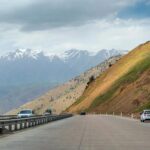
Shifting from the northern steppes to the southeastern reaches, we encounter the stunning Dzungarian Alatau mountains, a range rightly deserving inclusion in any list of underrated Kazakhstani wonders. They pale in popularity compared to the more famous Zailiysky Alatau, yet the wild beauty of the Jetysu Alatau, as they’re alternatively known, is utterly captivating. Nestled in their foothills are hidden treasures: Kazakhstan’s highest waterfall, Burkhan-Bulak, cascading dramatically; the Dzungarian Gates, once a vital artery for Silk Road caravans; and Zhasylkol Lake, a serene expanse beloved by marals (Asiatic deer) and offering profound tranquility.
The renowned Altyn-Emel National Park, with its Singing Dunes, volcanic mountains, healing springs, and petroglyphs, lies at the base of these peaks. Nearby, the Kalakai sanctuary evokes ancient rituals and sacrifices, with the imagined rhythms of shamanic drums echoing through the air. Listing all the special places in the Dzungarian Alatau feels impossible—it’s a grand mountain chain harboring ancient fortresses, breathtaking lakes, and picturesque canyons. The alpine meadows, ablaze with vibrant, fragrant flowers, are a paradise for beekeepers producing the most exquisite natural honey.
In connection with the Dzungarian Alatau, special mention must go to the Sievers apple tree—a wild species that humanity domesticated long ago. Now on the brink of extinction, this ancient fruit finds its strongest refuge here, with about 49% of its remaining wild groves concentrated in these mountains. As the ancestor of many modern varieties, including the famous Almaty Aport, it’s listed in Kazakhstan’s Red Book. First described by botanist I. Sievers in 1793, from whom it takes its name, this apple tree symbolizes the region’s biodiversity and historical significance.
Venturing into the Dzungarian Alatau promises extraordinary discoveries. Every stone, canyon, and river seems tied to a legend—perhaps those hills are not mere mounds but slumbering batyrs, heroic warriors resting after epic battles. The landscape invites storytelling, blending myth with reality in a way that captivates the imagination.


Our journey continues to the city of Baikonur, a destination shrouded in secrecy and significance. Accessing this place is no easy feat; both the city and the cosmodrome bear a special status, once veiled in mystery during the Soviet era. Vague descriptions of “somewhere in the Kazakh steppes” were deliberate, as Baikonur’s secrets were fiercely guarded. Today, entry requires proper documentation, but the effort is worthwhile for those intrigued by the birthplace of the space age, situated on the banks of the Syr Darya River.
In Baikonur, all paths lead to the Museum of the History of the Baikonur Cosmodrome, where visitors can trace the evolution of rocket and space technology, the conquest of space, and the ethnography of the region. Exhibits include models of launch vehicles, spacecraft, fragments of rocket hardware, spacesuits, personalized flight suits autographed by cosmonauts, samples of space food, and biological aid kits—a mere glimpse into the museum’s vast collection.
Along Korolev Avenue, named after the renowned Soviet rocket designer Sergei Pavlovich Korolev, stands a monument to Yuri Gagarin, the first man in space. A photo here is an absolute must for every visitor. About 500 meters away, commemorating the cosmodrome’s 20th anniversary, is the Soyuz launch vehicle, erected as a monument. Both the Gagarin statue and the rocket reside in Peace Park, where a bust of Mikhail Yangel (another Soviet rocket engineer) is flanked by a massive intercontinental missile, the 15A15 (SS-17).
Continuing along Korolev Avenue to Seyfullin Street, one encounters a monument to the cosmodrome’s pioneers, followed by a small square hosting the “Glory to the Conquerors of Space” stele. On Gagarin Street, a mosaic panel depicts a cosmonaut in open space with outstretched arms. At the other end of the same street lies a garden dotted with various stelae and monuments, including the “Space and Science” stele, an emblem of the city. Strolling the streets, you’ll stumble upon models of fighters and rockets, each a nod to Baikonur’s pioneering legacy.
Our odyssey through Kazakhstan’s underrated attractions continues, drawing us further into the country’s diverse wonders. Leaving the cosmic echoes of Baikonur behind, we turn westward to the enigmatic Caspian Sea—a body of water often called a sea, though it’s technically the world’s largest lake. As a descendant of the ancient Tethys Ocean, dating back about 10 million years, the Caspian is a veritable treasure trove of minerals and oil reserves. In Soviet times, ambitious plans to drain it entirely for its “black gold” were hatched but mercifully abandoned. Its shores and waters teem with remarkable wildlife, including prized fish species, and it accounts for the majority of the world’s caviar production, that luxurious delicacy harvested from its depths.
The primary resort town on Kazakhstan’s Caspian coast is Aktau, where beachgoers find a unique blend of relaxation. While it can’t rival tropical paradises, Aktau offers its own charms: sprawling sandy beaches, hotel complexes, cafes, restaurants, medical points, showers, and more for those seeking comfort. For adventurers, secluded wild beaches beckon, untouched by crowds. The beach season stretches from May through September or October, inviting sun-soaked escapes.
Kazakhstan’s Caspian shoreline may lack lush vegetation, but along the northern shore near the Kigach River, a miraculous sight unfolds: the world’s northernmost lotus plantation. These exotic blooms, sacred to many Southeast Asian cultures, thrive here against all odds, their pink petals painting the blue-green waters in a scene of pure enchantment. This section of the Caspian is protected under Kazakhstan’s Red Book, a testament to its ecological importance and rarity. Witnessing the lotuses in full bloom evokes childlike wonder, as if the sea itself has donned a floral crown.


Departing the ancient Caspian, we journey nearly 3,000 kilometers southeast to Almaty Oblast, where the secluded Lake Tuzkol hides in the wilderness. Often likened to a miniature Dead Sea due to its high salinity, this gem remains largely unknown even to many Kazakhs, let alone international travelers. Yet, the trek here is richly rewarded.

Nestled between the steppe expanse and the Tian Shan ranges, the lake’s surface mirrors the country’s highest peak, Khan Tengri, creating a breathtaking vista. Bathing in its waters is an intense experience; one emerges coated in a crust of salt, so pack plenty of fresh water for rinsing afterward.
Khan Tengri itself, seemingly within arm’s reach, is no less formidable. Once considered the highest point in the Tian Shan, it was surpassed by Pik Pobedy, but its allure endures. Dubbed the “Bloody Mountain” for the crimson hues the sun paints on its marble slopes, this summit vexed topographers as early as the late 19th century. It’s a coveted goal for serious alpinists, demanding skill and perseverance. Scaling to 7,000 meters, where ancient legends speak of divine abodes, instills a profound sense of accomplishment and connection to the heavens.

The word “steppe” sends shivers down the spine of any true Kazakh, for it defines much of the nation and is synonymous with homeland. The vast Saryarka steppe, inscribed on UNESCO’s World Heritage List, sprawls across an immense territory brimming with attractions. If time and curiosity allow, venture into its expanses for an authentic glimpse of Kazakhstan. Key highlights include the Korgalzhyn and Naurzum reserves, magnets for birdwatchers and ornithologists worldwide. Naurzum’s lakes form part of migratory bird routes, offering sightings of endangered species and the spring bloom of rare Shrenk tulips. Eco-routes are designed for sustainable exploration, preserving the delicate beauty.
Korgalzhyn Reserve, dubbed the “bird bazaar,” lies just 130 km from the capital. It hosts rare avian species like pink flamingos and curly pelicans, alongside endemic flora and fauna. The world’s largest population of pink flamingos in Kazakhstan graces Tengiz Lake, one of the planet’s most unique water bodies.
Saryarka is a realm of wonders: historical monuments, ancient Buddhist temple ruins, necropolises, archaeological and memorial complexes, pristine sandy lakeshores, ravines, sacred mausoleums, and more. At its heart lies Ulutau, the cradle of nomadic civilizations, where echoes of ancestral tribes resonate.


Traveling east from Saryarka toward the Kazakh Altai reveals Lake Zaysan, one of the oldest and most beautiful lakes in the region. The mighty Irtysh River flows from it, and Zaysan captivates with its temperate waters, stunning landscapes, and distance from industrial hubs. Its clay-formed shorelines, with whimsical shapes, evoke fairy-tale dwellings. Historically revered, it has borne names like “Beautiful,” “General,” and “Noble,” but “Prince” (Zaysan) fits perfectly. At least six to eight times older than its western counterpart, the Caspian, Zaysan embodies timeless allure.
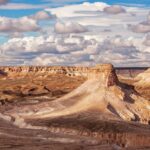
Mentioning Zaysan leads inevitably to the Kiin-Kerish ravine, a landscape that transports visitors to the Red Planet or the Mesozoic era. Orange-red clay cliffs create a Martian vista, while fossilized plant remains hint at a tropical past. Visitors have dubbed it the “Flaming Cliffs,” “Mars on Earth,” or “Land of Dinosaurs.” This fiery, otherworldly expanse guarantees a spot among life’s most astonishing adventures, blending geology, history, and imagination in a vivid tapestry.