Even if your Azerbaijani itinerary never lists “climb Beshbarmag Mountain,” you will still meet it. The crag stands like a silent customs officer beside the Baku–Guba highway, barely an hour north of the capital. Every north-bound traveler—truckers hauling fruit, families bound for the beaches of Gusar, backpackers chasing mountain silence—pulls over at its foot. Here a spontaneous bazaar unfurls: tiny grocery kiosks, smoke-wreathed kebab grills, cauldrons of black tea that never cool, long-haul rigs parked nose-to-tail with tour buses, and the constant hum of voices in Azerbaijani, Russian, Lezgi, English. Centuries ago this same patch of ground echoed with camel bells; today it resounds with diesel engines and laughter, yet the mountain still sets the pace of the day.
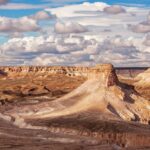
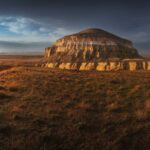
Look up and the reason becomes obvious. Beshbarmag rears skyward in a single, unbroken wall of limestone split by deep vertical fissures. Five distinct ridges run from summit to base, and when the light is right the whole massif resembles a gigantic hand thrust from the earth—five fingers spread against the sky. The Azerbaijani name says it plainly: besh means five, barmaq means finger. Local legend presses the image further: the mountain is the hand of a colossus who sleeps beneath the land, palm open, guarding the pass.
The reserve’s strategic location at the crossroads of two continents and two major bird migration routes is one of its most remarkable features. Situated between Europe and Asia, it serves as a key stopover for thousands of migratory birds each year. This intersection of migratory paths allows travelers to witness bird species that have disappeared from other parts of the world, making the reserve a vital center for maintaining natural ecological balance and supporting the avian journeys.

Sacred ground rarely shouts; it simply waits. Beshbarmag has waited since long before memory. In the era of Zoroastrian fire-worship it was already a shrine, one of the countless pirs—holy places—dotting Azerbaijan. This particular pir is known as Pir Khidir Zinda, dedicated to the prophet Khidr, or Khizr. His stories travel everywhere Islam has traveled, yet they pre-date Islam itself. Shiite villagers, Sufi dervishes, and curious agnostics all speak of Khizr as the undying wanderer who walks among mortals in disguise. He may appear as a barefoot beggar, as a stranded motorist needing a push, or as an old shepherd asking for water and bread. The test is simple: offer kindness without expectation, because you never know when the stranger is Khizr himself. Those who recognize him—so the tale goes—may ask for one wish, and the wish will be granted. The tradition is woven into the fabric of Caucasian hospitality: every guest could be Khizr, every open door an answered prayer.
The name Khizr, from the Arabic al-Khidr, means “the Green One.” In spring, when the foothills blaze with wild poppies and the air smells of thyme, the association feels inevitable. Legend claims that wherever Khizr rests in a desert, grass and flowers spring up overnight. The most famous story links him to Alexander the Great. In one version Khizr serves as Alexander’s most trusted warrior and is dispatched to find the Fountain of Life. After a perilous quest he discovers the spring, drinks, and fills a flask for his king, but the vessel shatters on the return journey—hence Alexander’s glory but mortal end. In another variant the two rulers journey together, reach twin springs—one of milk, one of cloudy water—and Alexander chooses incorrectly while Khizr drinks from the fountain of immortality. Whatever the version, the moral lingers: wisdom, not conquest, opens the door to eternity.

Each year thousands of pilgrims ascend Beshbarmag. A steep staircase hewn into the rock leads upward, then a narrow path threads between the “fingers,” squeezing through clefts barely shoulder-wide before spilling onto a windswept platform. From this balcony of stone the Caspian glitters cobalt to the east, while to the west the Greater Caucasus marches in serrated ranks. Tiny wind-twisted trees grow from cracks in the summit; their branches flutter with ribbons—red, yellow, turquoise, white—each scrap of cloth a whispered hope for health, success, or love. The custom feels ancient, older than any single creed, and it draws not only Muslims but Christians, Jews, Baháʼís, agnostics, and anthropologists tracing the threads of ritual across the Silk Road.
At the foot of the mountain, half-swallowed by grass, lie the remnants of Sasanid fortifications. North of the Absheron Peninsula, the Sassanians once built a chain of walls to seal the gap between mountains and sea. Most famous is Derbent’s great wall; in Azerbaijan the lone surviving fragment is Chirag-gala—“Lamp Castle”—in the Shabran district. Between Chirag-gala and Beshbarmag, beacon fires once flashed warnings of approaching armies. The mountain’s commanding view made it a watchtower long before it became a shrine.
Modernity has traded signal fires for headlights, yet Beshbarmag still guards travelers. Since Soviet times the cliff has been a training ground for Azerbaijani climbers. On weekends the rock blooms with ropes and chalked hands; the Alpine Federation stages competitions here, and expedition teams rehearse on its limestone before heading to the high Caucasus. At the base, house-sized boulders provide a natural playground for boulderers and slackliners.

Beyond sport, the mountain nurtures quieter pleasures. Spring carpets the surrounding meadows with more than two hundred species of wildflowers—scarlet tulips, purple irises, yellow adonis. Picnickers spread blankets beneath blooming almond trees, and campers pitch tents where the fragrance of thyme drifts on the night breeze. After dark the sky turns obsidian, the Milky Way spills across it, and the only sound is the wind combing through grass. Dawn often arrives veiled in low cloud; Beshbarmag rises through it like an island in a white sea, its “fingers” suddenly revealed when a gust tears the mist aside.
Stay a day, or two, or three. Wander the slopes at sunrise when the rock glows amber and the Caspian lies still as mercury. Share tea with a truck driver who swears Khizr once fixed his engine with a twist of wire. Buy a pair of hand-knitted socks from a child who learned the pattern from her grandmother. Tie your own ribbon to a tree, or simply sit on the summit and listen to the wind. Somewhere between the crunch of gravel underfoot and the hush of cloud-shadow racing across the plain, you may sense the mountain’s oldest promise: that every traveler passes twice—once in the world of roads and timetables, and once in the realm where stone, sky, and story merge. And if, on your way back to the highway, you stop to help a stranger push a car out of the mud, keep an eye on the rear-view mirror. The man who waves goodbye might just disappear into the shimmer of heat above the asphalt, leaving only the faint scent of fresh grass where none should grow.