Uzbek cuisine is, in itself, a landmark for anyone visiting the country. Local food does not tolerate haste: it teaches you not only how to eat with pleasure, but how to live with it — slowly, attentively, with respect for ingredients and genuine joy for the people sharing the table with you.
Most travelers know Uzbek cuisine through its most famous ambassadors — plov, shashlik, lagman, and hearty soups. But beyond these well-known classics lies an entire world of lesser-known, deeply authentic, and incredibly flavorful dishes that rarely make it into guidebooks. Chances are, you’ve never even heard of many of them. Let’s change that.
Here’s a simple travel tip: if you see a line forming at a tandoor in spring — join it without hesitation. People don’t queue for nothing. Inside, kuk-samsa is being baked — a seasonal Uzbek pastry stuffed with fresh greens, a true springtime ritual and a natural reset after winter.
The filling varies not only from region to region but often from family to family. In the Fergana Valley, sorrel and green onions dominate, while in Tashkent you’ll more often find a fragrant mix of spinach, dill, and cilantro. The key ingredient, however, is always the same: freshly foraged greens, hand-picked at their peak.
I can personally vouch for this process — I’ve gathered the greens myself, shaped the pastries with my own hands, and watched them bake inside the glowing tandoor. And, of course, it never ends with just one pastry. Resistance is futile.


If you think fish plays a minor role in Central Asian cuisine, you simply haven’t visited Tashkent’s markets. Here, fish holds a respected place at the table. Kovurilgan-baliq may be harder to pronounce than to cook — the recipe is almost disarmingly simple.
Fresh carp is sliced into thick steaks and fried in a kazan with cottonseed oil until golden and crisp. Add onions, spices, and that’s it. The real secret lies in the oil itself: cottonseed oil gives the fish a distinctive nutty aroma that defines the dish.
It’s served without fuss — on a paper plate, with slices of tomato, lemon wedges, and a generous handful of fresh dill. This is minimalism at its finest: no elaborate presentation, just pure, honest flavor.
In Uzbekistan, shashlik is not merely meat on a skewer — it’s a philosophy. Charviy kabob takes this tradition to another level. Lamb is wrapped in a delicate layer of caul fat, marinated with onions, salt, pepper, and spices, then grilled over hot coals.
For the chef, this is a true test of skill: the meat must be wrapped carefully so it stays juicy and holds its shape while cooking. For the traveler, it’s an unforgettable experience — a kebab that melts in your mouth and releases an explosion of flavor with every bite.
Sometimes liver replaces meat, creating an even richer and more intense version. Either way, this is shashlik at its most indulgent.

Tuhum-barak surprised me — and that’s not something I say lightly as a professional chef. At first glance, they resemble ordinary dumplings. But once you start cooking them, you realize how demanding they are.
The dough must be thin and elastic yet strong enough to hold a liquid filling. Each dumpling is shaped with a small opening, into which a mixture of fresh eggs, milk, and butter is carefully poured. The opening is sealed instantly, and the dumpling goes straight into boiling water. This is not a one-person job — speed and coordination are essential.
Legend has it that tuhum-barak was once prepared specifically for a khan before his visit to the harem. Skill and dexterity were mandatory — the filling must never leak.
Inside, the result is magical: not a hard-boiled egg, but a delicate, creamy omelet that melts on the tongue. Served with clarified butter, sour cream, or fresh herbs, tuhum-barak makes a perfect breakfast or light lunch for those seeking something truly authentic.


In Samarkand, flatbread is a matter of pride — and friendly rivalry. Locals insist: “A flatbread baked outside Samarkand is no longer real flatbread.”
There’s even a legend about the Emir of Bukhara, who fell so deeply in love with Samarkand bread that he tried to recreate it at his palace. He brought in the baker, the flour, even the water — but the taste was still wrong. The missing ingredient, they say, was Samarkand air.
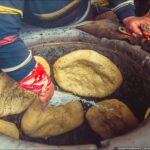
The scale of production is astonishing. Imagine a carpet-sized surface covered edge to edge with dough balls weighing over a kilogram each. The dough rests longer than some tourists on vacation — we waited nearly eight hours for it to reach the perfect state. This slow fermentation is what creates the airy crumb and crisp crust Samarkand bread is famous for.


Khasip is Uzbekistan’s answer to blood sausage — but with rice and a soul of its own. Lamb kidneys, lungs, heart, and spleen are finely chopped, mixed with rice, onions, and spices, then gently stuffed into natural casing.
The sausage is simmered slowly for at least three hours. When it finally arrives at the table — steaming, paired with fresh flatbread and a spoonful of spicy adjika — it’s pure comfort and deep satisfaction.

In Samarkand, nohat shurak is officially recognized as part of the region’s culinary heritage. Its name is legally protected, and only dishes prepared according to tradition can bear it.
The star ingredient is chickpeas, soaked for at least 12 hours to achieve their velvety texture. The recipe is intentionally minimal: lamb (preferably ribs or neck), chickpeas, onion, salt, pepper, cumin, and bay leaf. The soup simmers for hours, transforming into something between a rich broth and a hearty stew. The meat becomes meltingly tender, and the chickpeas absorb every nuance of flavor.
Samarkand plov is where history, legend, and flavor converge. Its defining feature is layered presentation. According to legend, Timur himself ordered plov to be served exactly as it cooked — without stirring. Rice first, then golden carrots, and meat on top.
This method preserves the integrity of each layer and ensures the plov remains light, fragrant, and never greasy or reheated.
Rice selection is crucial. At the Samarkand market, I was offered two options: alanga and lazer. The advice was simple: “For looks, take lazer. For taste, choose alanga.”
Samarkand plov is often made with beef, though lamb, quail, horse sausage (kazy), and other variations appear depending on the occasion. The kazan matters too — the more worn it is, the richer the flavor is believed to be.
Rice is sometimes added through cheesecloth so the layers remain distinct. Spices complete the dish: barberries, raisins, chickpeas, and occasionally saffron for aroma and color.
This is not just a meal — it’s a story served on a plate.