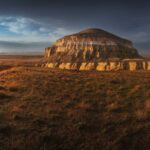
Nestled just an hour’s drive from the bustling heart of Baku—about 40 minutes by comfortable bus from the Koroglu metro station—lies the peculiar island-peninsula of Pirallahy. Despite its modest size of just 10 square kilometers, Pirallahy stands as Azerbaijan’s second-largest island and arguably its most intriguing. Separated from the eastern tip of the Absheron Peninsula by the eponymous strait and lapped by the Caspian Sea’s azure waves, this enigmatic landmass once bore the proud Soviet name of Artem and served as a hub for oil extraction. Over its storied history, it has morphed five times, shifting from peninsula to island and back, evolving from a pilgrimage site into a vanguard of the oil industry.

Pirallahy’s tale begins in ancient chronicles, with the earliest mentions tracing back to Arab accounts of the Rus’ raids on the Caspian in the 10th century. Back then, it was a peninsula, one of the most sacred spots along the western Caspian coast, known as “Allah-Akbar” (Allah is Great!). Scholars largely agree that its sanctuaries predated Islam, harking back to Zoroastrian times. Indirect evidence lies in the oil and gas fields that bubble near the surface, suggesting that parts of the peninsula were once a vast, eternally flaming territory—akin to the sacred fires at the Ateshgah Temple of Fire Worshippers or the famed Yanar Dag, the Burning Mountain. This holy ground, forbidden to those bearing arms or ill intent, bore witness to the Rus’ landings in 913-914 AD.


While exploring this region, visitors should not miss the Absheron National Park—the last 7.83 square kilometers of pristine Absheron Peninsula nature. Though it is Azerbaijan’s smallest national park, a mere speck compared to the 110.35 km² Altyaghach Reserve, Absheron National Park boasts two unique advantages: its proximity to the capital city and its role as the sole sanctuary preserving the peninsula’s untouched natural heritage.

Imagine the map of Azerbaijan as a soaring eagle, its beak dipping into the Caspian Sea. At the very tip of that beak lies this hidden gem. Unlike many parks, no public transport runs here, no villas or dachas mar its landscape, and roads are scarce. During Soviet times, it was a protected reserve—specifically a zakaznik—focused on safeguarding select species rather than entire ecosystems. The Absheron zakaznik was originally established to protect the rare goitered gazelle (jeyran) and the Caspian seal. In 2005, it was upgraded to a full-fledged national park.
Reaching the park requires a taxi or private vehicle; local drivers often don’t recognize its name, so be prepared to provide directions or use GPS. From central Baku, the journey takes about an hour, or roughly 40 minutes from Koroglu metro station. Entry costs a modest 2 manats (around $1.50). While vehicles are generally barred from entering, exceptions depend on negotiation skills and the season.


Absheron National Park is a realm of contrasts. It lacks lush shade, fresh water sources, and diverse flora or fauna during the typical visiting season. The real spectacle unfolds in winter when migratory birds flock here, transforming the landscape into a vibrant avian sanctuary—though the season brings bleak weather and challenging terrain. Some areas become marshy, even impassable, demanding courage and stamina from visitors.
Early autumn offers a peculiar delight: an abundance of water snakes, primarily checkerboard snakes, slithering through the wetlands. On land, snakes are plentiful too, some venomous, others harmless, making the park a haven for herpetologists and the curious alike.
For most, Absheron National Park is a place for quiet contemplation and long hikes—about 9 kilometers amid the classic Absheron scenery that is rapidly vanishing elsewhere on the peninsula. Birdwatchers equipped with binoculars or spotting scopes can spot a variety of species year-round. Mammals are elusive, blending into the rugged terrain; glimpses of foxes, wild boars, and badgers are rare and fleeting.
The park’s crown jewel, the goitered gazelle, remains elusive despite government efforts since 2010 to restore its population. Park officials proudly share photos and videos, but sightings are a matter of luck. Caspian seals, meanwhile, are a familiar sight to locals along the Absheron coast, as common as cats or dogs on the beach.
Birdlife is abundant and impressive, featuring swans, herons, flamingos, and numerous birds of prey. Yet, Absheron National Park is truly a destination for the discerning nature lover. While Azerbaijan boasts breathtaking reserves where nature’s beauty feels almost magical, every Baku resident should visit Absheron National Park at least once—to savor the unspoiled wilderness on their doorstep and witness where the northern and southern Absheron converge.