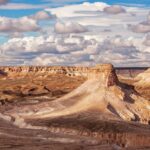
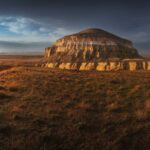
The extraordinary Jarakuduk Tract — whose name translates as “Well by the Cliff” — lies in the western part of the Mingbulak salt depression, the lowest point in Uzbekistan at 12.8 meters below sea level. Hidden in the heart of the vast Kyzylkum Desert, this surreal landscape was once part of the ancient Tethys Ocean millions of years ago.
The cliffs and canyons of Jarakuduk are a geological wonder, composed of intricate, layered formations. Throughout the Cretaceous period, this area repeatedly shifted between marine and continental environments, creating a spectacular natural “layer cake” of sediments. These deposits contain one of the richest collections of fossilized flora and fauna in all of Eurasia — known to science as the Bissect Suite. The age of these deposits spans an astonishing nine million years.
During numerous scientific expeditions, paleontologists have uncovered an abundance of fossilized marine creatures and fragments of ancient vertebrate skeletons. Among the discoveries are teeth of freshwater and brackish-water sharks, enormous scales of bony fish, turtle shell plates, crocodile teeth and vertebrae, lizard skull fragments, the remains of gigantic dinosaurs, fossilized bird vertebrae, and traces of ancient mammals and amphibians.
Experts agree that few places on Earth can match Jarakuduk in both the diversity and concentration of vertebrate fossils. The site continues to hold enormous scientific promise, as researchers believe entirely new species — previously unknown to science — may still lie hidden beneath its sands.
Yet Jarakuduk’s fame extends beyond its fossils. The area is home to an astonishing paleontological formation known as the “Stone Forest.” This unique phenomenon consists of numerous vertical, iron-encrusted tree trunks standing frozen in time. Within the same paleosoil layers, scientists have found countless fossilized imprints of leaves — likely from ancient plane trees. Similar “stone forests” exist only in a few places on Earth, such as Bulgaria and Chile.
The origins of these fantastic formations remain the subject of debate. According to one alternative theory, these are not petrified trees but rather “stone pipes” — columns of sand fused by extreme heat, rising up to four meters high and resembling the pipes of a grand organ.
Many of the rare specimens unearthed at Jarakuduk have already become prized exhibits at major museums across Uzbekistan, including the State Geological Museum, the Navoi Regional Museum of History and Local Lore, as well as the Zarafshan and Kyzylkum historical museums.
A journey through the Kyzylkum Desert is a thrilling yet perilous adventure, demanding preparation and caution. In this realm without roads — only directions — it’s easy to lose your way. The vast emptiness, shifting sands, and relentless sun make solo travel extremely dangerous. For safety, expeditions should only be undertaken with experienced guides and appropriate desert transport.


Despite its remote location, the “Stone Forest” area has recently been fenced and outfitted with a walking path, benches, and lanterns. Of course, the towering four-meter pillars that once stood here are now long gone — decades of unrestricted access took their toll. Still, it remains a captivating place to visit, to imagine yourself transported a hundred million years back in time, standing among the primeval flora and fauna — and then fast-forward through the ages to picture how this mysterious land has transformed since then.
Geographical coordinates: N42°06’45 E62°40’44