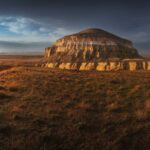
Travel routes in Armenia can be a test for the nerves: tour groups hurry past one another, there is bustle everywhere, some people rush to take photos, others are busy buying souvenirs. Yet Armenia also hides places where silence reigns and visitors are few. Here are three remote corners that can either captivate you with their solitude—or unsettle you with it.
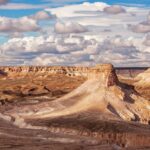
In the north-west of Shirak Province lies Lake Arpi, the second-largest reservoir of fresh water in Armenia, and one rarely visited by travelers.
Lake Arpi (Arpilich) rests at an altitude of 2,022 meters, and because of this height it is cold throughout the year. Its origin is tectonic. Millions of years ago a powerful underground volcanic eruption occurred in the north of what is now Shirak, creating a natural bowl that later filled with meltwaters. The climate here is continental; the lowest temperature ever recorded in Armenia – minus 46 degrees – was registered precisely in this region. And yet roughly one hundred species of birds live here, including the rare Armenian gull that cannot be seen in other parts of the country.
In the middle of the last century the lake was artificially enlarged for agricultural purposes and became a reservoir, losing some of its pristine wildness. Because Arpilich lies in a border zone and the roads leading to it are in very poor condition, locals generally visit only for fishing. In all other respects, this far-flung frontier landscape remains almost deserted throughout the year.


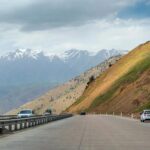
Not far from Yerevan, on the road to Garni near the village of Vokhchaberd, you can find a viewpoint that opens onto a magnificent panorama.
It is a small cuboid structure of tuff and basalt with two powerful arched openings. The arch was built in 1957 in honor of the 60th anniversary of the Armenian poet, prose writer, and translator Yeghishe Charents. Its architect, Rafael Israelyan—the creator of the “Mother Armenia” monument—designed it with striking simplicity. There are two stories explaining its creation. According to the romantic version, Charents, who devoted much of his work to praising Mount Ararat (Ağrı Dağı), loved this very spot and would sit for hours on the high hill, admiring the mountain’s beauty. The second version says that Israelyan noticed the place while driving past; his trained eye caught the enchanting perspective, and he decided to place a roadside structure there.
From the standpoint of architectural heritage the arch itself is modest. The surrounding terrain is sparse, almost rough. Its true uniqueness lies in the unimpeded view of the mountain, free from city blocks. Unlike the famous lookout at Khor Virap, which also offers one of the finest vistas of Ararat, the Charents Arch remains practically deserted—especially in bad weather, when the mountain is veiled by fog or clouds. It is best to visit on weekdays, as on weekends the occasional tour bus may stop for an extended photo session.
In the east of Syunik Province, eight kilometers from Goris, lies a village abandoned by its inhabitants many years ago.
Its name literally translates as “Apple Village.” The main attraction here is the cave city beside which the settlement was founded in the 13th century. According to the most widespread version, at that time the slopes of the gorge—on both sides of which Old Khndzoresk stretched—were covered with wild apple trees. The later name, Khor Dzor (“Deep Gorge”), emphasized how hard it was to reach the village, since the only way was to descend far down into the ravine. Old Khndzoresk endured until the middle of the last century, and only in the early 1970s did its last residents move to a new village built above the gorge.
An exposed and somewhat perilous suspension bridge leads to the abandoned village and to the cave town. Because the location is difficult to access and its area exceeds three square kilometers—much of it overgrown with dense forest—few travelers are eager to go there, all the more since it lies in a border region where demarcation works are underway. There are no tourist signs or wayfinding on the site, so visitors must think ahead about maps, water supplies, and mobile connection. Precisely this isolation, though, gives Old Khndzoresk its haunting power: a silent world where nature slowly reclaims stone and history whispers from the cliffs.