The Caucasus is one of the world’s most fascinating crossroads, where Europe meets Asia and ancient traditions blend seamlessly with modern life. This unforgettable 13-day journey invites you to discover the remarkable diversity of Azerbaijan, Georgia, and Armenia—three neighboring countries united by geography yet distinguished by their unique cultures, religions, languages, and histories.
Travel from the shores of the Caspian Sea to the majestic peaks of the Greater Caucasus, exploring a region renowned for its breathtaking landscapes, warm hospitality, and extraordinary cultural heritage. Wander through the medieval streets of Baku’s UNESCO-listed Old City, marvel at mysterious mud volcanoes and eternal flames, and uncover the ancient traditions of the Silk Road in the charming town of Sheki.
Crossing into Georgia, experience the legendary hospitality for which the country is famous. Enjoy authentic home-hosted cuisine in the celebrated wine region of Kakheti, taste wines produced using methods recognized by UNESCO, and explore the captivating capital of Tbilisi, where colorful balconies, historic churches, and contemporary architecture create an irresistible atmosphere. Venture into the heart of the Caucasus Mountains, visiting ancient cave cities, UNESCO monuments, and spectacular alpine landscapes beneath the towering summit of Mount Kazbek.
In Armenia, the world’s first Christian nation, discover centuries of history preserved in magnificent monasteries, many protected by UNESCO. Admire the serene beauty of Lake Sevan, explore the vibrant streets of Yerevan—one of the world’s oldest continuously inhabited cities—and visit iconic landmarks including Khor Virap, Geghard Monastery, Garni Temple, and the spiritual center of Echmiadzin.
Carefully designed for travelers seeking authentic cultural experiences, this small-group tour combines stunning scenery, fascinating history, local traditions, and unforgettable encounters. Accompanied by an experienced Spanish-speaking guide throughout the journey, you will gain a deeper understanding of a region that remains one of the world’s best-kept travel secrets.
Join us on an extraordinary adventure across the Caucasus and experience three nations, countless traditions, and memories that will last a lifetime.
Welcome to Azerbaijan, the fascinating “Land of Fire” and the first destination of your Grand Caucasus adventure. Upon arrival at Baku International Airport, you will be greeted and transferred to your hotel.
Located on the shores of the Caspian Sea, Baku is a city of striking contrasts where centuries-old architecture stands alongside futuristic skyscrapers. The Azerbaijani capital has transformed into one of the Caucasus region’s most dynamic and cosmopolitan cities while preserving its rich historical heritage.
Depending on your arrival time, you may wish to take a leisurely stroll along the elegant seaside boulevard or simply relax after your flight and prepare for the exciting discoveries ahead.
Overnight in Baku.
After breakfast, begin your exploration of Azerbaijan with an excursion south of Baku to one of the country’s most remarkable historical and natural treasures.
Your first destination is Gobustan National Park, a UNESCO World Heritage Site renowned for its extraordinary collection of prehistoric rock carvings. Spread across a dramatic semi-desert landscape overlooking the Caspian Sea, Gobustan preserves thousands of petroglyphs created by Stone Age inhabitants over several millennia. These ancient images depict hunting scenes, ritual dances, animals, boats, and daily life, providing a fascinating insight into early human civilization in the Caucasus.
The area is also known for its ancient caves and shelters, some of which contain artwork dating back nearly ten thousand years. Walking among these rocky formations offers a unique opportunity to connect with one of the oldest cultural landscapes in the region.
The journey continues to Azerbaijan’s famous mud volcanoes, a natural phenomenon for which the country is internationally known. More than half of the world’s mud volcanoes are found in Azerbaijan, creating an unusual lunar-like landscape of bubbling mud craters and mineral-rich formations. (The visit is subject to weather and road conditions.)
Returning to Baku, stop at Martyrs’ Lane, a memorial dedicated to those who lost their lives during key moments of Azerbaijan’s modern history. Beyond its historical significance, the site offers one of the finest panoramic viewpoints over Baku Bay and the city’s spectacular skyline.
In the afternoon, enjoy a guided walking tour through the atmospheric Old City, known locally as Icherisheher. Encircled by imposing medieval walls, this UNESCO-listed quarter preserves the essence of historic Baku with its winding alleys, traditional caravanserais, ancient mosques, and stone mansions.
The highlight of the old town is the magnificent Palace of the Shirvanshahs, the former residence of the rulers of the Shirvan Kingdom, which flourished as one of the most influential states in medieval Azerbaijan. The palace complex consists of several beautifully preserved structures and represents one of the finest examples of medieval Islamic architecture in the Caucasus.
You will also see the iconic Maiden Tower, the most recognizable symbol of Baku. Rising above the old city, this mysterious 12th-century monument remains one of Azerbaijan’s greatest architectural enigmas and an important UNESCO-listed landmark.
Return to the hotel.
Overnight in Baku.
Today’s excursion introduces you to the natural wonders and spiritual heritage of the Absheron Peninsula, a region that gave Azerbaijan its nickname, the “Land of Fire.”
The first stop is the Ateshgah Fire Temple, one of the country’s most intriguing historical monuments. Built by merchants and pilgrims travelling along ancient trade routes, this unique sanctuary served as a place of worship for Zoroastrians, Hindus, and other fire-worshipping communities. For centuries, natural gas escaping from the earth fueled eternal flames that made the site a sacred destination for travelers from across Asia.
Continue to Yanardag, or the “Burning Mountain,” where natural gas has been emerging from the hillside and burning continuously for decades. Flames dance across the rocky slope throughout the year, creating a spectacular display that illustrates the geological forces hidden beneath the Absheron Peninsula.
During the return to Baku, make a photo stop near the striking Heydar Aliyev Center, one of the most celebrated examples of contemporary architecture in the world. Designed by the renowned architect Zaha Hadid, the building’s flowing curves and futuristic design have become a symbol of modern Azerbaijan.
The remainder of the day is at leisure. You may choose to explore Baku independently, visit one of its museums, enjoy shopping in the city center, or take a walk along the Caspian waterfront.
Overnight in Baku.
After breakfast, depart Baku and travel northwest through the scenic landscapes of central Azerbaijan toward the historic Silk Road town of Sheki.
Along the way, stop at the remarkable Diri Baba Mausoleum, dramatically built into a rocky cliff near the village of Maraza. Surrounded by legends and mystery, this medieval monument appears to emerge directly from the mountainside and remains one of the country’s most distinctive architectural landmarks.
The journey continues to Shamakhi, the former capital of the Shirvan Kingdom and one of Azerbaijan’s oldest cities. Here, visit the historic Juma Mosque, one of the oldest mosques in the Caucasus region. Originally established in the eighth century, the mosque has played a significant role in the religious and cultural life of the region for centuries.
Upon arrival in Sheki, discover one of the most charming towns in the Caucasus. Nestled among forested hills and once an important trading center on the Silk Road, Sheki is renowned for its rich history, traditional crafts, and beautifully preserved architecture.
The city’s crown jewel is the magnificent Palace of the Sheki Khans. Although relatively modest in size, the palace is considered one of the finest masterpieces of Azerbaijani architecture. Its richly decorated interiors feature colorful murals depicting royal life, hunting scenes, floral motifs, and intricate geometric patterns. Particularly impressive are the palace’s famous stained-glass windows known as shebeke, handcrafted without the use of nails or glue. Some sections contain thousands of tiny pieces of colored glass assembled into breathtaking mosaic designs.
To better understand this unique artistic tradition, visit a local shebeke workshop where skilled craftsmen demonstrate the techniques used to create these intricate stained-glass masterpieces. You will also have the opportunity to learn about the painstaking process behind this centuries-old art form.
Later, travel to the nearby village of Kish to visit one of the oldest Christian monuments in the Caucasus. Perched on a hillside overlooking the surrounding countryside, the ancient Church of Kish is believed to stand on the site of an early Caucasian Albanian sanctuary dating back to the first centuries of Christianity. The church provides valuable insight into the region’s multicultural and multi-religious heritage.
After a day filled with history, architecture, and cultural discoveries, transfer to your hotel in Sheki.
Overnight in Sheki.
After breakfast, leave Sheki and travel towards the border between Azerbaijan and Georgia. Following border formalities, continue into Georgia, a country celebrated for its ancient traditions, remarkable hospitality, and spectacular landscapes.
Your first destination is Kakheti, Georgia’s premier wine-producing region. Surrounded by fertile valleys and framed by the snow-capped peaks of the Greater Caucasus Mountains, Kakheti is considered the heart of Georgian winemaking. Archaeological evidence suggests that wine has been produced here for more than 8,000 years, making Georgia one of the oldest wine-producing nations in the world.
A special highlight of the day is a traditional lunch hosted by a local family. This authentic experience offers a unique opportunity to discover Georgian culture through its cuisine and hospitality. Enjoy homemade dishes prepared according to family recipes, sample fresh seasonal produce from the garden, and learn about local customs while sharing a meal with your hosts.
Later, visit the picturesque hilltop town of Sighnaghi, often referred to as the “City of Love.” Encircled by impressive defensive walls dating back to the eighteenth century, Sighnaghi enchants visitors with its cobbled streets, colorful houses, carved wooden balconies, and beautifully restored architecture. From its elevated position, the town offers breathtaking views across the fertile Alazani Valley and the majestic Caucasus Mountains beyond.
The journey continues with a visit to a traditional winery, where you will discover Georgia’s unique method of wine production using large clay vessels known as qvevri. This ancient winemaking technique, recognized by UNESCO as Intangible Cultural Heritage, has been passed down through generations and remains an essential part of Georgian identity. Enjoy a tasting of locally produced wines while learning about the history and traditions that make Georgian wine culture so distinctive.
In the late afternoon, continue to Tbilisi, Georgia’s vibrant capital city. Upon arrival, check in to your hotel and enjoy the evening at leisure.
Overnight in Tbilisi.
Today is dedicated to exploring Tbilisi, one of the most fascinating and atmospheric capitals in the Caucasus. Situated along the banks of the Mtkvari River, the city reflects centuries of cultural exchange between Europe and Asia and combines ancient landmarks with contemporary architecture.
Begin your sightseeing tour at the historic Metekhi Church, dramatically positioned above the river and offering excellent views of the Old Town. From here, continue through Tbilisi’s charming historic quarter, where narrow streets wind between colorful houses adorned with beautifully carved wooden balconies.
As you stroll through the city’s oldest neighborhoods, discover a fascinating blend of architectural styles shaped by Persian, Arab, Byzantine, Russian, and European influences. Historic churches, hidden courtyards, traditional houses, and lively squares create a unique atmosphere unlike anywhere else in the region.
Visit the ancient Narikala Fortress, one of Tbilisi’s most iconic landmarks. Standing high above the city, this centuries-old citadel provides magnificent panoramic views over the rooftops, churches, and modern skyline below.
Continue to the famous sulfur bath district, where naturally heated mineral waters have attracted visitors for centuries. These historic bathhouses played an important role in the city’s development and gave Tbilisi its name, which derives from the Georgian word for “warm.”
The tour also includes a walk along Rustaveli Avenue, the city’s elegant main boulevard lined with theaters, museums, government buildings, cafés, and shops. Throughout the day, you will gain a deeper understanding of Georgia’s rich history and contemporary culture.
Return to the hotel.
Overnight in Tbilisi.
After breakfast, depart Tbilisi and travel to Mtskheta, the ancient capital of the Georgian kingdom and one of the country’s most important spiritual centers. With a history stretching back nearly three millennia, Mtskheta occupies a special place in Georgian culture and religion.
Visit the hilltop Jvari Monastery, a masterpiece of early medieval architecture that overlooks the confluence of the Aragvi and Mtkvari rivers. The breathtaking setting has inspired poets, artists, and travelers for generations.
Continue to Svetitskhoveli Cathedral, one of the most revered religious monuments in Georgia. According to tradition, it houses sacred relics associated with the life of Christ. Both Jvari Monastery and Svetitskhoveli Cathedral are recognized as UNESCO World Heritage Sites and represent some of the finest examples of medieval Georgian architecture.
The journey then leads to Uplistsikhe, one of the oldest cave settlements in the Caucasus. Carved directly into the rock, this remarkable city flourished as an important trading and religious center along ancient caravan routes connecting Europe and Asia. Explore its network of tunnels, temples, halls, wine cellars, living quarters, and defensive structures while learning about the civilizations that once inhabited this extraordinary site.
In the afternoon, continue north along the famous Georgian Military Highway, one of the most scenic roads in the Caucasus. As the route climbs higher into the mountains, enjoy spectacular views of dramatic valleys, rivers, and towering peaks.
Arrive in Gudauri, Georgia’s premier mountain resort situated at an altitude of approximately 2,000 meters above sea level. Surrounded by breathtaking alpine scenery, Gudauri offers a peaceful setting in the heart of the Greater Caucasus Mountains.
Dinner and overnight in Gudauri.
This morning travel deeper into the Caucasus Mountains towards the spectacular region of Kazbegi, one of Georgia’s most celebrated natural destinations.
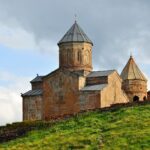
Following the course of the Terek River, arrive in Stepantsminda, the principal town of the region. Here begins one of the most rewarding experiences of the journey: a hike to the iconic Gergeti Trinity Church.
The trail gradually ascends through beautiful mountain landscapes, crossing meadows, forests, and panoramic viewpoints before reaching the church, which stands dramatically at an elevation of 2,170 meters above sea level. The location offers unforgettable views of the surrounding valleys and mountains.
Weather permitting, admire the majestic Mount Kazbek, rising to 5,047 meters and ranking among the highest peaks in the Caucasus. Its glacier-covered summit has inspired numerous legends and remains one of the most recognizable mountain landscapes in the region.
After spending time at the church and enjoying the scenery, descend back to Stepantsminda.
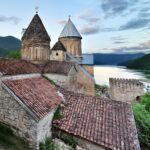
In the afternoon, return towards Tbilisi. Along the way, stop at the impressive Ananuri Fortress Complex, a beautifully preserved medieval stronghold overlooking the turquoise waters of the Jinvali Reservoir. The combination of historic architecture and stunning natural surroundings makes this one of the most photogenic sites in Georgia.
Continue to Tbilisi and check in at your hotel.
Overnight in Tbilisi.
After breakfast, leave Georgia and travel south towards the Armenian border. Following border procedures and a change of vehicle and guide, begin your exploration of Armenia, the world’s first officially Christian nation.
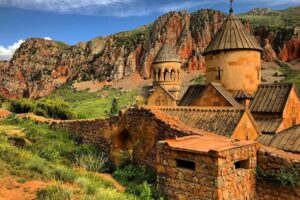
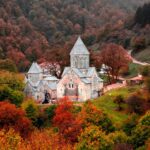
The first major stop is Haghpat Monastery, one of Armenia’s most important medieval religious and educational centers. Founded in the tenth century, this UNESCO World Heritage Site represents a masterpiece of Armenian ecclesiastical architecture. Set amidst beautiful mountain scenery, the monastery complex contains churches, chapels, bell towers, and monastic buildings that reflect the spiritual and cultural achievements of medieval Armenia.
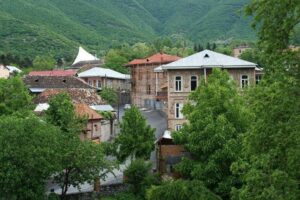
Continue through the forested landscapes of northern Armenia to Dilijan, often called the “Armenian Switzerland” due to its lush forests, rolling hills, and pleasant climate. The town is renowned for its natural beauty, traditional architecture, and mineral springs. Surrounded by national parks and mountain scenery, Dilijan offers a refreshing contrast to the more rugged landscapes encountered earlier in the journey.
The route then leads to one of Armenia’s greatest natural treasures: Lake Sevan. Located approximately 2,000 meters above sea level, this vast alpine lake is among the largest high-altitude freshwater lakes in the world. Its deep blue waters, framed by mountain ranges and open skies, create one of the most memorable landscapes in the Caucasus. The lake occupies nearly five percent of Armenia’s territory and has played an important role in the country’s history, economy, and culture for centuries.
Enjoy time to admire the scenery and capture photographs before continuing to the Armenian capital.
Arrive in Yerevan in the evening. Often referred to as the “Pink City” because of the distinctive volcanic stone used in many of its buildings, Yerevan is one of the world’s oldest continuously inhabited cities. Its lively atmosphere, broad boulevards, and impressive cultural heritage make it a fitting final chapter of your Caucasus adventure.
Check in to your hotel.
Overnight in Yerevan.
After breakfast, begin the day with a comprehensive tour of Yerevan, the capital of Armenia and one of the world’s oldest continuously inhabited cities. Founded in 782 BC, Yerevan predates many of Europe’s most famous capitals and combines a rich historical legacy with a vibrant contemporary atmosphere.
Your exploration starts in Republic Square, the heart of the city and one of Armenia’s most recognizable landmarks. Surrounded by elegant government buildings, museums, and cultural institutions constructed from distinctive pink volcanic tuff stone, the square represents a fine example of traditional Armenian architecture adapted to modern urban design.
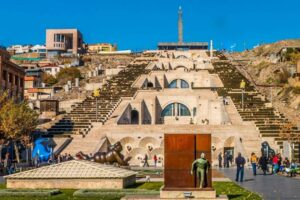
Continue to the impressive Cascade Complex, a giant stairway and open-air art center that has become one of Yerevan’s cultural symbols. Along its terraces are fountains, sculptures, gardens, and exhibition spaces. Among the many works of art displayed here is the famous “Cat” sculpture by renowned Colombian artist Fernando Botero. From the upper levels of the Cascade, enjoy magnificent panoramic views over Yerevan, with Mount Ararat often visible on the horizon.
The city tour also includes views of the Opera House, one of Armenia’s most important cultural venues, and Victory Park, where the monumental Mother Armenia statue overlooks the capital from above.
Leaving Yerevan, travel to Ashtarak, a charming provincial town whose name translates as “tower.” Located in the Aragatsotn region, Ashtarak is known for its historic churches, picturesque setting above the Kasagh River Gorge, and authentic Armenian atmosphere. Here, visit Karmravor Church, one of the country’s smallest yet most beautiful medieval churches. Remarkably preserved through the centuries, this modest structure offers a glimpse into Armenia’s early Christian architectural traditions.
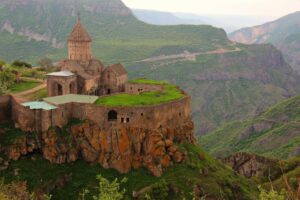
The journey continues to Saghmosavank Monastery, known as the “Monastery of Psalms.” Perched dramatically above the deep Kasagh Canyon, the monastery commands breathtaking views across one of Armenia’s most impressive natural landscapes. Founded during the thirteenth century, Saghmosavank remains an outstanding example of medieval Armenian religious architecture and a place of remarkable tranquility.
A unique highlight of the day is a visit to the Armenian Alphabet Monument. Created to commemorate the 1,600th anniversary of the Armenian alphabet, the site features giant stone sculptures representing each of the alphabet’s 39 letters. Travelers often enjoy finding and photographing the letter corresponding to their own name while learning about the importance of the Armenian script, one of the world’s oldest alphabets still in use today.
Return to Yerevan in the evening.
Overnight in Yerevan.
Today’s excursion focuses on Armenia’s deep spiritual heritage and the landmarks associated with the adoption of Christianity as the country’s state religion.
After breakfast, travel south through the fertile Ararat Plain to the famous Monastery of Khor Virap. This spectacular site is one of Armenia’s most cherished pilgrimage destinations and enjoys an unforgettable setting against the backdrop of Mount Ararat, the legendary mountain traditionally associated with Noah’s Ark.
Khor Virap is closely linked to Saint Gregory the Illuminator, who played a decisive role in Armenia’s conversion to Christianity in the early fourth century. According to tradition, Gregory was imprisoned here for many years before eventually converting King Tiridates III and helping establish Armenia as the first nation in the world to adopt Christianity as a state religion.
The panoramic views from the monastery towards Mount Ararat are among the most iconic in the entire Caucasus region and provide outstanding photographic opportunities.
Continue to Echmiadzin, the spiritual center of the Armenian Apostolic Church and often referred to as the “Vatican of Armenia.” According to tradition, Christ himself revealed the location where the cathedral should be built. Constructed in the early fourth century, Echmiadzin Cathedral is regarded as one of the oldest Christian cathedrals in the world and remains the official seat of the Catholicos, the head of the Armenian Church.
The journey then proceeds to the archaeological site of Zvartnots, whose name translates as the “Temple of the Heavenly Angels.” Built during the seventh century, the cathedral was once considered one of the most magnificent churches in the Christian world. Although largely destroyed by an earthquake centuries ago, the surviving ruins still convey the grandeur and architectural sophistication of this UNESCO World Heritage Site.
After exploring these extraordinary monuments, return to Yerevan.
Overnight in Yerevan.
Today combines Armenia’s pre-Christian past, medieval monastic heritage, and contemporary cultural life.
Following breakfast, travel east of Yerevan to visit the extraordinary Monastery of Geghard, one of Armenia’s most treasured religious sites and a UNESCO World Heritage Site. Nestled within a dramatic canyon and surrounded by towering cliffs, Geghard is unique for its churches and chapels carved directly into the rock face.
The monastery’s origins date back to the fourth century, although much of the present complex was constructed during the medieval period. The site’s remarkable architecture, acoustics, and spiritual atmosphere make it one of the most memorable landmarks in Armenia. Its name, Geghard, refers to the Holy Lance that, according to tradition, pierced Christ during the Crucifixion and was once preserved here.
Continue to the nearby village of Garni, home to the only standing Greco-Roman colonnaded temple in the former Soviet Union. Built during the first century AD, the Temple of Garni was dedicated to Mithra, the sun god, and provides fascinating insight into Armenia’s pagan history before the arrival of Christianity. Set on a plateau overlooking a dramatic river gorge, the temple offers impressive views of the surrounding landscape.
Returning to Yerevan, visit the Tsitsernakaberd Memorial Complex, dedicated to the victims of the Armenian Genocide of 1915. The memorial serves as an important place of remembrance and reflection and provides valuable historical insight into one of the most significant events in modern Armenian history.
The day continues with a visit to Vernissage, Yerevan’s famous open-air arts and crafts market. Often described as a living museum, Vernissage is the ideal place to discover traditional Armenian handicrafts and souvenirs. Stalls display an extraordinary variety of items including handmade jewelry, carpets, ceramics, wood carvings, paintings, textiles, silverwork, and traditional decorative arts.
Before returning to the hotel, explore one of Yerevan’s colorful fruit markets, where local vendors offer an abundance of fresh produce, dried fruits, nuts, spices, sweets, and regional specialties. This lively market provides a wonderful opportunity to experience everyday Armenian life and sample some of the country’s traditional flavors.
Overnight in Yerevan.
After breakfast, enjoy some free time depending on your flight schedule.
At the designated time, transfer to Yerevan International Airport for your departure flight.
As your Grand Caucasus Journey comes to an end, take with you unforgettable memories of three remarkable countries, from the futuristic skyline of Baku and the vineyard-covered valleys of Georgia to the ancient monasteries of Armenia. Over thirteen days, you have crossed continents, discovered UNESCO World Heritage Sites, experienced diverse cultures and religions, explored breathtaking mountain landscapes, and encountered the legendary hospitality of the Caucasus.
Departure.
| Fixed Dates | Price per person |
|---|---|
| 05 – 17 July, 2026 | $3140 |
| 02 – 14 August, 2026 | $3140 |
| 16 – 28 August, 2026 | $3140 |
| 06 – 18 September, 2026 | $3140 |
| 04 – 16 October, 2026 | $3140 |
* – based on 3-4* hotel accommodation / Single Supplement – $575
  All transportation throughout the tour
  Sightseeing tour program with a Spanish speaking guide
  Entrance fees to the museums, mausoleums and other sights
  Hotel accommodation (shared double/twin room)
  Any Private Expenses
  Lunches, Dinners (Full board)
  Tips are not included, but would be appreciated
  Travel insurance
| Accommodation |
|---|
| 3 nights in 4* hotels in Baku 1 nights in 4* hotel in Sheki 3 nights in 3* hotels in Tbilisi 1 night in 4* hotel in Gudauri 4 nights in 3* hotels in Yerevan |